
Deep dive into diaper backsheet printing technology: flexographic vs gravure, ink safety, print resolution, registration, color management and what brand owners must specify.
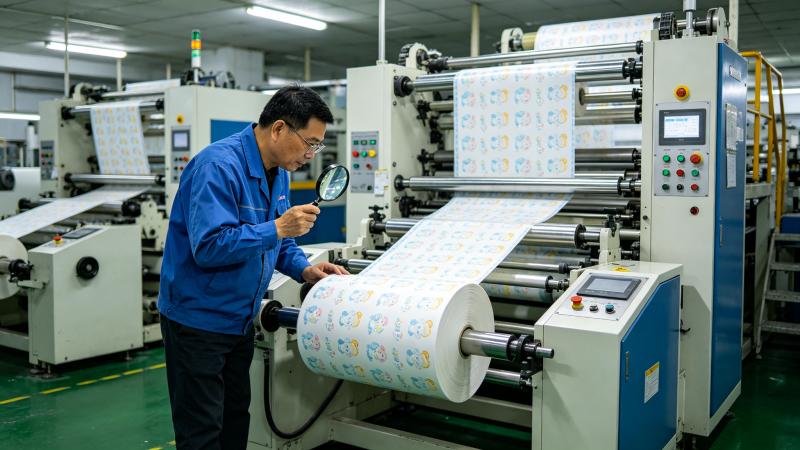
The backsheet is the largest printable surface on a baby diaper, and the quality of its print directly influences how consumers perceive your brand. A sharp, vibrant, consistent backsheet print communicates premium quality; a dull, misregistered, or inconsistent print signals cheap manufacturing — even if the diaper's absorbent core is identical. Understanding diaper backsheet printing technology is essential for any brand owner who wants to specify print requirements accurately, evaluate manufacturer capabilities, and avoid costly print defects in mass production.
This article is part of our cluster on custom printed baby diapers manufacturer in China.
Backsheet Materials and Printability
Before discussing printing methods, it is important to understand what is being printed on. Modern diaper backsheets are typically one of three material types, each with different print characteristics.
Polyethylene (PE) film. The most common backsheet material, PE film is a thin (15-25 micron) breathable or non-breathable polyethylene film. PE film prints cleanly with flexographic or gravure methods, holds fine detail well, and has a smooth surface that produces vibrant colors. Most budget and mid-tier diapers use printed PE film backsheets.
Non-woven fabric. Premium diapers often use a non-woven fabric (typically polypropylene spunbond) laminated onto PE film as the outer backsheet layer. Non-woven surfaces are textured and fibrous, which softens print appearance and reduces sharpness. Printing on non-woven requires higher ink volume, lower line screen, and specialized ink formulations to achieve acceptable color density. Some manufacturers print on the underlying PE film and then laminate non-woven on top, achieving a softer visual effect while maintaining print quality.
Composite or coated film. Some premium backsheets use a coated PE film with a matte or soft-touch surface coating that changes print behavior. These coatings can produce a premium tactile feel but may require UV-cured inks or special surface treatment to achieve adequate ink adhesion.
Flexographic Printing: The Industry Standard
Flexographic printing (flexo) is the dominant printing method for diaper backsheet film, accounting for more than 90% of custom printed baby diapers produced in China. It is a rotary relief printing method that uses flexible polymer or rubber plates mounted on printing cylinders. Ink is transferred from an anilox roller (a engraved metal roller that carries a precise volume of ink) to the raised image areas on the plate, then to the substrate.
Advantages of Flexographic Printing for Diapers
Speed. Modern flexographic presses run at 300-600 meters per minute, matching the speed of diaper converting lines. This allows inline or near-inline printing and converting, reducing handling and lead time.
Cost at scale. Flexographic plates are relatively inexpensive ($300-$800 per color) compared to gravure cylinders ($1,500-$3,000 per color), making flexo more economical for moderate to large production runs.
Water-based ink compatibility. Flexographic presses handle water-based inks well, which is critical for diaper applications where ink safety and low odor are paramount. Water-based inks dry quickly on PE film, are non-toxic, and produce minimal VOC emissions.
Substrate versatility. Flexo can print on PE film, non-woven fabric, and composite materials with appropriate ink and plate adjustments, making it suitable for the full range of diaper backsheet types.
Limitations of Flexographic Printing
Resolution. Flexographic printing typically achieves 120-175 lines per inch (lpi), compared to 200-300 lpi for gravure. This means very fine text (below 6pt), thin lines (below 0.1mm), and photographic gradients may not reproduce as sharply. Brand owners should avoid designs with fine reverse text (white text on a dark background) below 8pt, as these can fill in during printing.
Registration. Modern servo-driven flexographic presses achieve registration accuracy of ±0.1mm to ±0.15mm, which is adequate for most diaper patterns. However, registration can drift over long runs or when film tension varies, requiring periodic press adjustments.
Color gamut. Flexographic printing with water-based inks has a slightly narrower color gamut than gravure with solvent-based inks, particularly in deep blues, reds, and oranges. Brand owners with critical brand colors should request physical color drawdowns before approving designs.
Gravure Printing: Premium Option
Gravure printing (rotogravure) uses engraved copper cylinders that carry ink in recessed cells. A doctor blade removes excess ink from the cylinder surface, and the ink in the cells transfers to the substrate under pressure. Gravure is used for premium diaper brands that require photographic-quality print, very high color density, or extremely long production runs (5 million+ pieces).
When to Choose Gravure
Choose gravure printing if your backsheet design includes photographic images, complex gradients, very fine detail, or if you require absolute color consistency across multi-million-piece annual volumes. Gravure cylinders last for millions of impressions without degradation, whereas flexographic plates may need replacement after 500,000-1,000,000 impressions. For a brand producing 10 million+ pieces per year of a single design, gravure can be more cost-effective despite higher initial tooling costs.
Gravure Limitations for Diapers
Gravure printing traditionally uses solvent-based inks, which can leave residual odors and require more rigorous drying and curing. While water-based and UV-cured gravure inks are available, they are less common and may require specialized press configurations. Gravure cylinders are expensive and have long lead times (2-3 weeks), making gravure less suitable for fast-changing designs or small-batch production. Most China diaper manufacturers use flexographic printing for custom orders and reserve gravure for high-volume stock designs.
Digital Printing: Emerging Niche
Digital inkjet printing for flexible packaging is an emerging technology that allows variable data printing, zero setup costs, and very short run lengths. For diaper backsheets, digital printing is currently limited to prototype samples, marketing test batches, and ultra-premium niche products because of high per-unit costs and speed limitations. Digital print resolution (up to 1200 dpi) exceeds both flexo and gravure, and it can produce photographic-quality images without plates. However, digital printing speeds (50-150 meters per minute) are too slow for mass-market diaper production, and ink adhesion on PE film remains a challenge. Most brand owners will use digital printing for pre-production samples and then switch to flexographic for mass production.
Ink Systems for Diaper Backsheet Printing
Ink selection is the most safety-critical decision in diaper backsheet printing. Diaper print inks must be non-toxic, non-irritating, low-odor, and compliant with regulations in every market where the product is sold.
Water-Based Inks
Water-based inks are the standard for diaper backsheet flexographic printing. They use water as the primary carrier, with acrylic or polyurethane resins as binders and pigments for color. Water-based inks dry by evaporation and absorption, produce minimal VOC emissions, and are generally recognized as safe for indirect skin contact. They are available in a wide color range and can be formulated for specific substrates (PE film, non-woven, coated film). Limitations include slightly lower color density than solvent-based inks and longer drying times, which can limit press speed on high-coverage designs.
UV-Cured Inks
UV-cured inks dry instantly when exposed to ultraviolet light, producing a hard, durable print surface with excellent scratch resistance and high color density. They contain no solvents and produce zero VOC emissions. However, UV inks are more expensive, require specialized UV curing stations on the press, and can produce a slightly glossy surface that may not match the matte finish of PE film. For diaper applications, UV inks are typically used for premium packaging rather than backsheet printing, because the hard cured surface can reduce the soft feel of the backsheet.
Solvent-Based Inks
Solvent-based inks were historically used for gravure printing on PE film because they produce vibrant colors, excellent adhesion, and fast drying. However, they contain organic solvents (typically ethyl acetate, toluene, or methyl ethyl ketone) that can leave residual odors and require rigorous drying to meet food-contact and skin-contact safety standards. Most major diaper brands have moved away from solvent-based inks for backsheet printing due to odor, safety, and environmental concerns. If a manufacturer proposes solvent-based inks for your diaper backsheet, request full residual solvent test reports and confirm that levels are below regulatory limits (typically <5 mg/m² for total residual solvents in food-contact materials).
Key Print Specifications Brand Owners Must Define
To ensure consistent, high-quality backsheet printing, brand owners should define the following specifications in their purchase agreements and artwork briefs.
Color specifications. Provide Pantone Solid Coated or CMYK values for all brand-critical colors. Specify acceptable Delta E tolerance (≤3.0 for critical colors, ≤5.0 for decorative elements). Require the factory to provide color drawdowns on the actual backsheet material for approval before plate making.
Print resolution and minimum element size. Specify minimum line weight (≥0.15mm for flexo), minimum positive text size (≥6pt), minimum reverse text size (≥8pt), and minimum dot size (≥2% for highlights). Designs with elements below these thresholds may not reproduce reliably and should be modified during the design review stage.
Registration tolerance. Specify maximum registration deviation (±0.15mm to ±0.3mm depending on design complexity). Designs with fine overlapping elements or tight color-to-color registration require tighter tolerances and may incur higher production costs.
Ink type and safety standards. Explicitly require water-based inks (or UV-cured if specified), and list required safety certifications: heavy metal test (EN 71-3 or equivalent), phthalate test (REACH Annex XVII), migration test (EU 10/2011 or FDA 21 CFR), and total residual solvent (<5 mg/m² if solvent-based inks are used).
Print durability. Specify rub resistance (e.g., 50 cycles with 1kg weight, no visible ink transfer), flexibility (no cracking after 20% stretch), and adhesion (tape test: no ink removal after applying and removing 3M 610 tape).
Inspection and AQL. Define acceptable quality limits for print defects: critical defects (missing print, major color error, ink transfer) AQL 0.65; major defects (minor color variation, slight misregistration, small smudges) AQL 2.5; minor defects (cosmetic issues that do not affect function or brand identity) AQL 4.0.
Common Print Defects and How to Prevent Them
Understanding common print defects helps brand owners identify issues during sample approval and incoming inspection, and communicate effectively with the manufacturer's print team.
Color variation. The most common print defect, color variation occurs when the printed color does not match the approved reference. Causes include ink batch variation, press speed changes, drying temperature variation, and substrate batch differences. Prevention: approve physical color drawdowns, require spectrophotometer measurement at the start of each run and every 2 hours during production, and retain reference samples from each batch for comparison.
Misregistration. Misregistration appears as color fringing, blurred edges, or visible gaps between color layers. Causes include plate mounting errors, film tension variation, press speed changes, and cylinder calibration drift. Prevention: require registration marks on each design, inspect registration on the first 100 sheets of each run, and specify maximum acceptable registration deviation in the purchase agreement.
Ink transfer or set-off. Ink transfer occurs when wet ink from the printed surface transfers to the back of the film during winding or stacking. Causes include insufficient drying, high ink coverage, and high winding tension. Prevention: ensure the press has adequate drying capacity (hot air and/or IR dryers), limit solid ink coverage to 85% or less where possible, and use slip sheets or low-tension winding for high-coverage designs.
Pinholes or voids. Pinholes are small unprinted spots in solid coverage areas, caused by dust on the plate, ink bubbles, or poor ink transfer. Prevention: require clean room conditions in the printing area, use filtered ink systems, and inspect solid coverage areas under magnification during sample approval.
Plate wear or degradation. Over long runs, flexographic plates can wear, causing loss of fine detail, reduced color density, or halo effects around printed elements. Prevention: specify maximum run length per plate set (typically 500,000-1,000,000 impressions), require plate inspection at regular intervals, and budget for plate replacement for annual volumes exceeding 1 million pieces per design.
Questions to Ask Your Manufacturer About Backsheet Printing
When evaluating a custom printed baby diapers manufacturer in China, ask these specific questions about their backsheet printing capability:
- How many flexographic printing presses do you operate in-house, and what is their maximum color capability and print width?
- What is the typical registration tolerance your presses achieve in production, and how is registration monitored during runs?
- What ink suppliers do you use, and can you provide current test reports for heavy metals, phthalates, and migration?
- What is your standard lead time for plate making, color matching, and pre-production samples?
- How many rounds of design revisions and sample approvals are included in the standard price?
- What is your minimum order quantity for custom backsheet printing, and do you offer reduced MOQs for first-time partners?
- How do you handle color consistency across multiple production batches, and can you provide batch-to-batch color measurement reports?
- What is your maximum run length per plate set, and what is the cost and lead time for plate replacement?
- Can you provide printed samples from at least three previous custom print projects for evaluation?
- Do you offer digital printing for prototype samples before committing to flexographic plates?
Frequently Asked Questions
What is the difference between flexographic and gravure printing for diapers?
Flexographic printing uses flexible polymer plates and water-based inks, running at 300-600 m/min with resolution of 120-175 lpi. It is the industry standard for diaper backsheets due to speed, cost, and ink safety. Gravure printing uses engraved copper cylinders, typically with solvent-based inks, achieving higher resolution (200-300 lpi) and longer plate life, but at higher tooling cost and with potential odor concerns. Most custom diaper orders use flexographic printing.
What type of ink is used for diaper backsheet printing?
Water-based inks are the standard for diaper backsheet flexographic printing. They use water as a carrier, acrylic or polyurethane binders, and pigments, producing non-toxic, low-odor prints that are safe for indirect skin contact. UV-cured inks are used for some premium applications, while solvent-based inks are increasingly avoided due to residual odor and safety concerns.
What is the minimum line weight and text size for flexographic diaper printing?
For flexographic printing on diaper backsheet film, specify minimum line weight of 0.15mm, minimum positive text of 6pt, and minimum reverse (white on dark) text of 8pt. Elements below these thresholds may fill in, blur, or fail to reproduce consistently in mass production.
How do I ensure my brand colors print accurately on diaper film?
Provide Pantone Solid Coated or CMYK values with a Delta E tolerance of ≤3.0 for critical colors. Request physical color drawdowns on the actual backsheet material before plate making, approve pre-production samples under standardized lighting (D65), and require the factory to measure color with a spectrophotometer at the start of each production run and every 2 hours during production.
Can I print photographic images on a diaper backsheet?
Photographic images are possible with flexographic printing but may appear softer than on paper or packaging due to the 120-175 lpi resolution and the textured surface of non-woven backsheets. For best results, use high-contrast images with limited fine detail, avoid subtle gradients, and request physical samples before approving. Gravure printing produces better photographic quality but at higher cost and with potential ink safety considerations.
Conclusion
Backsheet printing is both a brand differentiator and a technical challenge. Brand owners who understand flexographic printing capabilities, ink safety requirements, and print specification standards can communicate effectively with manufacturers, avoid costly design revisions, and ensure consistent, high-quality print across production batches. The key is to work with a manufacturer that operates in-house flexographic presses, uses water-based food-grade inks, employs formal color management systems, and has a design team that can guide your artwork from concept to production-ready files.
← Back to Custom Printed Baby Diapers Manufacturer Guide | Next: Verify Print Quality & Color Consistency →