Complete guide to custom printed baby diapers from a China manufacturer. Covers backsheet printing, packaging design, waistband print, MOQ, cost, quality standards and factory selection.
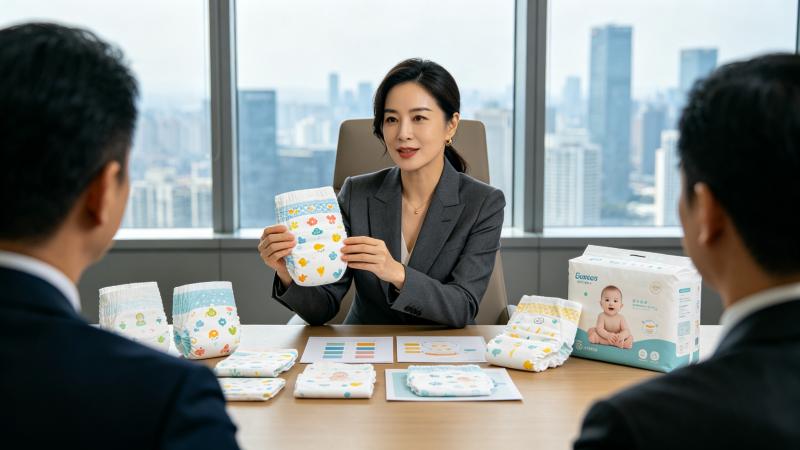
When a brand owner decides to launch a private label diaper line, one of the most visible differentiators is the print. A custom printed baby diaper — with branded backsheet patterns, coordinated waistband designs, and professionally designed packaging — does more than look attractive on a retail shelf. It signals quality, builds brand recognition, and creates a sensory experience that parents associate with your product. Finding the right custom printed baby diapers manufacturer in China determines whether your print vision becomes a consistent, market-ready product or a series of costly compromises.
China produces more than half of the world's disposable baby diapers, and the manufacturing cluster in Fujian province — particularly Quanzhou — is the global center for diaper printing and converting. Factories in this region operate high-speed flexographic presses, automated converting lines, and in-house design teams that can take a brand from concept to container in as little as 45 days. This guide walks through every decision a brand owner faces when sourcing custom printed baby diapers from a China manufacturer, including print technology, packaging design, cost structure, quality verification, and factory selection.
It is part of our content cluster on becoming a diaper distributor through a China factory brand partnership.
What Does "Custom Printed" Mean for Baby Diapers?
Custom printing in baby diapers covers four distinct surfaces, each with its own technology, cost structure, and design constraints. A comprehensive custom printed baby diapers manufacturer in China should offer all four, though not every brand needs all of them at launch.
Backsheet Printing
The backsheet — the outer, non-woven or polyethylene layer that faces outward — is the primary canvas for diaper print. Most premium and mid-tier diapers carry repeating patterns, character illustrations, or geometric designs printed directly onto the backsheet film before converting. The print must withstand the converting process, remain flexible after lamination, and use inks that are safe for incidental skin contact. Learn more about backsheet printing technology in our detailed guide.
Waistband and Frontal Tape Printing
The elastic waistband and the frontal tape (landing zone) offer additional branding real estate. Waistband printing typically uses repeating logos or patterns that stretch with the elastic material. The frontal tape can carry a branded design or a functional pattern that helps caregivers align the tape tabs. Both require inks and adhesives that maintain print integrity under repeated stretching. Read our guide to waistband and frontal tape custom printing.
Packaging Printing
The outer packaging — resealable poly bags, cardboard cartons, or plastic canisters — is where most consumers first encounter your brand. Packaging print involves structural design, graphic layout, regulatory labeling, and finish options (matte, gloss, soft-touch). A manufacturer with in-house packaging design capability can coordinate diaper print and packaging print for a cohesive brand identity. Explore our private label packaging design guide.
Accessory and Component Printing
Some brands extend custom printing to auxiliary components: tape tabs with printed logos, acquisition layer patterns visible through the topsheet, or indicator strips with custom color transitions. These are premium options that add cost but can significantly enhance perceived quality.
Why China for Custom Printed Baby Diaper Manufacturing?
Three structural advantages make China — and specifically the Fujian Quanzhou cluster — the default choice for brands seeking custom printed baby diapers at scale.
Vertical integration of printing and converting. Leading Chinese diaper manufacturers operate their own flexographic printing presses in-house, rather than outsourcing print to a separate converter. This means the film is printed, laminated, and converted into diapers on the same campus, reducing lead times, minimizing transportation damage, and allowing tighter quality control between print and converting.
Scale and cost efficiency. A factory with 60+ automated converting lines and monthly capacity exceeding 500 million pieces can amortize plate costs, setup fees, and engineering overhead across large production runs. This translates to lower unit costs for custom printed diapers compared to manufacturers in Europe, North America, or Southeast Asia that operate at smaller scale.
Design and engineering capability. Established Chinese manufacturers employ in-house graphic designers, print engineers, and product developers who can translate a brand's design files into production-ready artwork, recommend print modifications for manufacturability, and produce physical pre-production samples for approval before mass production begins.
How to Choose a Custom Printed Baby Diapers Manufacturer in China
Selecting the right manufacturer is the single most important decision in a custom print project. Use this seven-factor evaluation framework to compare candidates systematically.
1. In-House Printing Capability
Verify that the factory owns and operates its own printing equipment, rather than outsourcing print to a third party. Ask for the number of flexographic presses, maximum print width, color capability (typically 6-8 colors), and whether they can print both backsheet film and non-woven materials. In-house printing ensures tighter quality control and faster problem resolution when print issues arise.
2. Print Quality and Color Management
Request printed samples from previous projects and examine them under both natural and artificial light. Check for color consistency across samples from different production batches, registration accuracy (how well multiple color layers align), and print sharpness on curved or textured surfaces. A factory with formal color management systems — including Pantone matching, Delta E measurement, and standardized lighting booths — will produce more consistent results. Learn how to verify print quality and color consistency.
3. Ink Safety and Regulatory Compliance
Diaper print inks must be non-toxic, non-irritating, and compliant with regulations in your target market. In the EU, printed materials that may contact skin must comply with REACH and the Toy Safety Directive's migration limits. In the US, the FDA regulates indirect food contact additives, and many retailers require additional third-party testing. Ask the manufacturer for ink supplier certificates, test reports for heavy metals and phthalates, and confirmation that inks are water-based or UV-cured (not solvent-based, which can leave residual odors). ISO 13485 certification for medical device quality management is a strong indicator of process discipline.
4. Design and Pre-Press Support
A good manufacturer does more than execute your design files. Their design team should review artwork for print feasibility, flag potential issues (fine lines that may blur, colors that may shift on non-woven substrates, gradients that may band), and provide digital proofs and physical samples before production. Ask whether they charge for design revisions, how many sample rounds are included, and what file formats they accept (AI, PDF, PSD, CDR).
5. Production Capacity and Lead Time
For custom printed orders, lead time is longer than for stock designs because of plate making, color matching, and sample approval. A typical timeline is 7-15 days for sample approval, 15-25 days for mass production, and 7-15 days for sea freight. Verify that the factory has available capacity on both printing and converting lines during your target production window, and ask whether they can accommodate rush orders if needed.
6. Minimum Order Quantity (MOQ)
Custom printing always carries a higher MOQ than stock designs because of plate costs and setup time. For backsheet printing, MOQ typically starts at 100,000-200,000 pieces per design per size. Waistband printing may require 200,000-500,000 pieces. Packaging MOQ is usually lower — 5,000-10,000 bags or cartons. Some manufacturers offer lower MOQs for first orders to help new brands launch, but expect higher unit costs for small runs. Understand the full MOQ and cost structure for custom printed diapers.
7. Audit and Transparency
Request a factory audit report (BSCI, Sedex, or ISO 9001), and if possible, conduct an in-person or virtual factory tour. Walk the printing area, the converting lines, the quality inspection station, and the warehouse. Ask to see their ink storage, waste handling, and worker safety protocols. A transparent factory will show you everything; a factory that restricts access to certain areas may be outsourcing production or cutting corners.
The Custom Printing Process: From Design to Delivery
Understanding the production timeline helps brand owners plan launches and avoid delays. Here is the standard workflow at a custom printed baby diapers manufacturer in China.
Step 1 — Design submission and review (3-5 days). You submit your artwork files. The manufacturer's design team reviews them for print feasibility, makes minor adjustments if needed, and sends a digital proof for your approval.
Step 2 — Plate making and color matching (5-7 days). Once the digital proof is approved, the factory makes printing plates (typically polymer or steel-backed polymer for flexographic printing) and creates initial color drawdowns for your approval. This is the stage where you confirm that the printed colors match your brand guidelines.
Step 3 — Pre-production samples (5-7 days). The factory prints a small batch of film, converts it into finished diapers, and ships physical samples to you for final approval. This is your last chance to make changes before mass production; changes after this stage incur additional plate and setup costs.
Step 4 — Mass production (15-25 days). With sample approval, the factory schedules production on the printing press and converting lines. Quality inspectors perform in-line checks at both printing and converting stages, including color verification, registration checks, and visual defect inspection.
Step 5 — Packaging and inspection (3-5 days). Finished diapers are packed into your custom-printed packaging, cartons are labeled with batch codes and shipping marks, and a final random inspection (AQL 2.5 or 4.0, depending on your agreement) is performed before shipment.
Step 6 — Shipping (7-30 days). Goods are loaded into containers and shipped by sea (25-30 days to Europe, 15-20 days to the US West Coast) or by air (3-7 days, significantly more expensive). Some manufacturers offer DDP (Delivered Duty Paid) shipping, handling customs clearance and last-mile delivery for an additional fee.
Quality Standards for Printed Baby Diapers
Print quality is not just about aesthetics — poor print can cause functional issues and regulatory problems. Here are the key quality parameters to specify and verify.
Color consistency. Define your brand colors using Pantone Solid Coated or CMYK values, and specify an acceptable Delta E tolerance (typically ≤ 3.0 for critical brand colors, ≤ 5.0 for decorative patterns). The factory should measure color using a spectrophotometer under standardized lighting (D65 or D50).
Registration accuracy. Multi-color prints require precise alignment of each color layer. For diaper backsheet printing, registration tolerance is typically ±0.15mm to ±0.3mm. Misregistration appears as color fringing or blurred edges, particularly on fine text or sharp boundaries.
Print durability. The print must withstand the converting process (lamination, folding, cutting), remain intact during packaging and transport, and not transfer or rub off during normal use. Specify a rub test (e.g., 50 cycles with a 1kg weight, no visible transfer) and a flexibility test (print must not crack when the film is stretched 20%).
Ink migration and odor. Printed inks must not migrate through the film to the inner layers, and must not produce detectable odors. Specify that inks are water-based or low-migration UV-cured, and request third-party test reports for overall migration (OM) and specific migration (SM) according to your target market's regulations.
Defect rate. Define acceptable defect rates for print-related issues: misprints, color variation, smudges, missing print, and design distortion. Typical AQL levels for critical defects (missing print, major color error) are 0.65 or 1.0, and for major defects (minor color variation, slight misregistration) are 2.5 or 4.0.
Cost Overview for Custom Printed Baby Diapers
Custom printing adds several cost layers beyond the base diaper unit cost. Understanding these components helps you budget accurately and negotiate effectively.
Plate and setup costs. Each unique design requires printing plates, typically costing $300-$800 per color per design. For a 6-color backsheet design, plate costs alone can reach $1,800-$4,800. Setup fees for printing and converting add $500-$1,500 per order. These are one-time costs per design; reorders of the same design incur only setup fees, not plate costs.
Unit cost premium. Custom printed diapers carry a unit cost premium of 5%-15% over stock designs, depending on print complexity, number of colors, and order volume. Simple 2-color patterns add less; full-bleed 8-color photographic prints add more. At high volumes (500,000+ pieces), the per-unit premium decreases because fixed costs are amortized.
Packaging costs. Custom-printed packaging adds $0.02-$0.08 per unit for resealable poly bags, or $0.10-$0.30 per unit for premium cartons. Minimum order quantities for packaging are usually lower than for diaper printing, allowing more flexibility.
Sample and tooling costs. Pre-production samples typically cost $200-$500 per round (including shipping), though some manufacturers waive sample fees for first orders above a certain volume. Custom cutting dies or forming tools for unique packaging shapes can add $500-$2,000.
For a detailed breakdown of MOQ thresholds, cost structures, and strategies to reduce print costs, read our dedicated MOQ and cost guide.
Why New Yifa Group for Custom Printed Baby Diapers
New Yifa Group, headquartered in Putian, Fujian — within the Quanzhou diaper manufacturing cluster — offers end-to-end custom printing capability for baby diaper brands worldwide.
In-house flexographic printing. Our factory operates high-speed flexographic printing presses with up to 8-color capability, printing directly onto polyethylene backsheet film and non-woven materials. In-house printing means tighter quality control, shorter lead times, and direct communication between your design team and our print engineers.
Design and pre-press team. Our in-house graphic design and pre-press team reviews every artwork submission for print feasibility, provides digital proofs within 48 hours, and produces physical pre-production samples for your approval. We accept AI, PDF, PSD, and CDR file formats and offer up to three rounds of design revisions at no additional cost for first-time partners.
Safe, compliant inks. We use water-based, food-grade inks from established suppliers, with full test documentation for heavy metals, phthalates, and migration. Our printing process is certified under ISO 13485 medical device quality management and ISO 9001, and our products comply with EU REACH, US FDA, and various national safety standards.
Scale and capacity. With 68 automated converting lines and monthly capacity exceeding 980 million pieces, we can accommodate both initial launch orders (MOQ from 100,000 pieces per design) and large-scale replenishment orders. Our dual 100,000-class clean rooms ensure that printed materials are handled in a controlled environment from printing through converting.
Full private label support. Beyond printing, we offer complete OEM/ODM services including product formulation, structural design, packaging design, and export documentation. Learn more about our private label and brand partnership programs, or explore our production capabilities.
Frequently Asked Questions
What is the minimum order for custom printed baby diapers from China?
For backsheet custom printing, MOQ typically starts at 100,000-200,000 pieces per design per size. Waistband printing may require 200,000-500,000 pieces. Packaging MOQ is lower, usually 5,000-10,000 units. Some manufacturers offer reduced MOQs for first-time brand partners.
How long does it take to produce custom printed diapers?
The full timeline from design submission to container loading is typically 35-55 days: 3-5 days for design review, 5-7 days for plate making and color matching, 5-7 days for pre-production samples, 15-25 days for mass production, and 3-5 days for final inspection and packing. Sea freight adds 15-30 days depending on destination.
Can I print my own design on the diaper backsheet?
Yes. Most China diaper manufacturers accept custom artwork for backsheet printing. You provide design files (AI, PDF, or PSD), and the manufacturer's pre-press team adapts them for flexographic printing, makes plates, and produces samples for your approval before mass production.
What printing method is used for baby diaper backsheets?
Flexographic printing is the dominant method for diaper backsheet film, using water-based inks. It is fast, cost-effective at scale, and produces durable prints on flexible polyethylene and non-woven substrates. Some premium applications use gravure printing for higher resolution, but flexographic is the industry standard for baby diapers.
How do I ensure color consistency across production batches?
Specify your colors using Pantone or CMYK values with an acceptable Delta E tolerance (≤3.0 for critical colors). Require the factory to measure color with a spectrophotometer under standardized lighting, retain reference samples from each batch, and conduct incoming inspection on every shipment. A factory with formal color management systems will provide batch-to-batch color reports.
Are custom printed diapers more expensive than stock designs?
Yes. Custom printing adds plate costs ($300-$800 per color), setup fees ($500-$1,500), and a unit cost premium of 5%-15%. However, at volumes above 500,000 pieces, the per-unit premium decreases significantly, and custom printing can improve brand recognition and justify a higher retail price.
Getting Started
Custom printed baby diapers are one of the most effective ways to differentiate a private label brand in a crowded market. The key to success is choosing a manufacturer with in-house printing capability, rigorous color management, safe ink systems, and a design team that understands both your brand vision and the constraints of high-speed converting.
If you are evaluating custom printed baby diapers manufacturers in China, contact New Yifa Group for a free consultation and custom quote. Our team can review your design files, provide print feasibility feedback, and produce pre-production samples within 15 days. You can also learn more about our R&D and design capabilities or read about our 30-year history in diaper manufacturing.
Related articles: Diaper Backsheet Printing Technology | Custom Diaper Packaging Design | Waistband & Frontal Tape Printing | MOQ & Cost Structure | Print Quality & Color Verification