
Guide to custom printing on diaper waistbands and frontal tapes. Covers elastic material compatibility, ink adhesion, logo placement, design constraints, MOQ and quality verification.
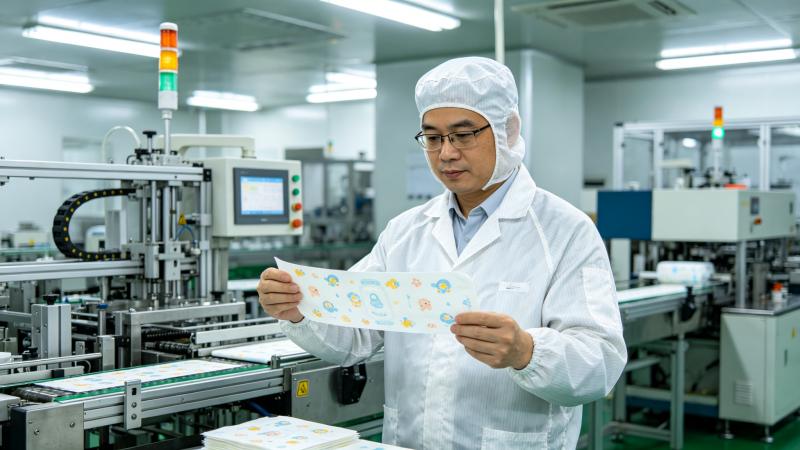
While the backsheet carries the largest printable surface on a baby diaper, the waistband and frontal tape are the most visible elements when a diaper is worn or being changed. A custom-printed waistband with a repeating brand pattern or a frontal tape with a coordinated design transforms a functional diaper into a branded garment. However, printing on elastic materials and adhesive-coated substrates presents unique technical challenges that many brand owners — and even some manufacturers — underestimate. Understanding these constraints is essential to achieving durable, consistent, and visually appealing waistband and frontal tape printing.
This article is part of our cluster on custom printed baby diapers manufacturer in China.
Anatomy of the Diaper Waistband
The waistband (also called the elastic waist or back ear) is the elasticated panel at the back of the diaper that wraps around the baby's waist. It is typically composed of multiple layers: a non-woven outer layer, elastic strands (typically 5-15 strands of Lycra or spandex), a non-woven inner layer, and adhesive bonding between layers. The waistband stretches 2-3 times its resting length and must return to its original shape without sagging or losing elasticity after repeated wear.
Printing on the waistband means printing on the outer non-woven layer before elastic attachment and lamination. The print must withstand the stretching process, remain flexible, and not crack or flake when the waistband is extended. This requires specialized inks, printing methods, and quality testing that differ from standard backsheet printing.
Waistband Printing Methods
Flexographic Printing on Non-Woven
The most common method for waistband printing is flexographic printing directly onto the non-woven outer layer before elastic lamination. Flexographic presses print water-based inks onto the non-woven surface at high speed (300-500 m/min), and the printed non-woven is then fed directly into the waistband lamination station. Because non-woven is a porous, fibrous material, ink absorption is higher than on PE film, requiring higher ink volume and lower line screen (80-120 lpi) to achieve acceptable color density.
Inkjet Digital Printing
Some high-speed diaper converting lines use inline inkjet digital printing for waistband patterns, particularly for variable data or short-run custom designs. Digital inkjet can print directly onto the waistband material at converting speed, with no plates or setup costs, making it ideal for limited-edition designs, regional market variations, or personalized products. However, digital inkjet on non-woven has lower color density and resolution than flexographic, and ink adhesion on elastic materials can be challenging. Most mass-market custom waistband printing still uses flexographic methods.
Pre-Printed Film Lamination
An alternative approach is to print on a thin PE film (using standard flexographic backsheet printing methods) and then laminate the printed film onto the waistband non-woven. This produces sharper, more vibrant print than direct printing on non-woven, because PE film has a smooth surface that holds fine detail better. However, adding a printed film layer increases waistband stiffness, reduces breathability, and adds cost. This method is used by some premium brands that require photographic-quality waistband patterns.
Ink Requirements for Elastic Waistband Printing
Printing on elastic materials requires inks that can stretch with the substrate without cracking, flaking, or losing adhesion. Standard water-based inks formulated for PE film may crack when the waistband is stretched, because the ink film is rigid and does not have the same elongation properties as the elastic non-woven.
Elastic Ink Formulations
Specialized elastic (or stretchable) inks contain flexible resin binders (typically polyurethane or modified acrylic) that allow the dried ink film to stretch 100-300% without cracking. These inks are more expensive than standard water-based inks (20-50% higher cost) and may require longer drying times or higher drying temperatures to achieve full cross-linking. Elastic inks are available in water-based and UV-cured formulations; water-based elastic inks are more common for diaper waistband applications due to safety and odor considerations.
Ink Adhesion Testing
Because the waistband stretches repeatedly during wear, ink adhesion is the critical quality parameter. Standard adhesion tests for waistband print include:
- Tape test: Apply 3M 610 or equivalent tape to the printed surface, rub firmly, and remove rapidly. No ink should transfer to the tape.
- Stretch test: Stretch the printed waistband to 200% of its original length and release. Repeat 10 times. No cracking, flaking, or ink loss should be visible.
- Rub test: Rub the printed surface with a weighted white cloth (500g, 50 cycles). No ink transfer to the cloth and no visible wear on the print.
- Wet rub test: Dampen the printed surface with synthetic urine or water, then rub with a weighted cloth. No ink transfer or smudging.
Waistband Design Constraints
Designing for waistband printing requires understanding the physical constraints of the material and the printing process. These guidelines help avoid designs that cannot be reliably produced.
Repeating Patterns Over Solid Coverage
Waistband printing works best with repeating patterns, logos, or text elements rather than full-bleed solid color coverage. Solid coverage on elastic non-woven is difficult to achieve consistently because the material stretches unevenly, causing the ink film to crack or separate. Repeating patterns (e.g., small logos every 20-30mm, geometric patterns, character illustrations) distribute ink coverage more evenly and are more forgiving of registration and stretch variations.
Element Size and Spacing
Minimum element size for waistband printing on non-woven is larger than for backsheet PE film: minimum line weight 0.3mm, minimum positive text 10pt, minimum reverse text 14pt. Elements should be spaced at least 5mm apart to avoid ink bridging when the material stretches. Avoid fine details, thin borders, and small text that may distort or become illegible when the waistband is extended.
Color Considerations
Color density on non-woven waistband is lower than on PE film because the porous material absorbs ink. Specify colors that work well at lower density: medium to dark colors (navy, red, green, dark gray) reproduce better than pastels or light tints. If light colors are required, consider pre-printing a white base layer (underprint) before applying the color, though this adds a printing station and cost. Brand colors on the waistband may not match backsheet colors exactly due to substrate differences; specify a wider Delta E tolerance (≤5.0) for cross-substrate color matching.
Elastic Direction and Print Orientation
Waistband elastic strands run horizontally (left to right), so the material stretches horizontally. Print elements should be oriented to accommodate horizontal stretch: text should read horizontally (not vertically), circular elements may become slightly oval when stretched, and vertical lines may bow outward. Design patterns that look good both at rest and when stretched to 200% extension. Avoid designs that rely on perfect geometric symmetry, as stretch will distort symmetry.
Frontal Tape (Landing Zone) Printing
The frontal tape (also called the landing zone, target zone, or front patch) is the rectangular panel on the front of the diaper where the tape tabs fasten. It is typically made of a non-woven or film material with a special coating that allows the tape tabs to adhere and reposition multiple times. Printing on the frontal tape serves both functional and branding purposes: a printed pattern or design helps caregivers align the tape tabs correctly, and a branded design reinforces brand identity during diaper changes.
Frontal Tape Materials and Print Compatibility
Frontal tapes are typically made of polypropylene non-woven (spunbond or thermobonded), polyethylene film, or a composite of both. The surface may be treated with a silicone or proprietary coating to provide the right balance of tack and release for the tape tabs. Printing on coated frontal tape materials requires inks that adhere to the coating without compromising the tape's adhesive performance. If the ink covers the entire frontal tape surface, it may reduce the tape tab's ability to adhere, causing the diaper to come undone during wear. For this reason, frontal tape printing typically uses partial coverage (patterns, borders, or centered designs) rather than full-bleed coverage.
Frontal Tape Design Guidelines
Functional alignment patterns. Many brands print a subtle pattern (dots, grid lines, or a central logo) on the frontal tape to help caregivers align the tape tabs symmetrically. The pattern should be visible but not distracting, and should not interfere with tape adhesion. A common approach is to print a thin border around the edges of the frontal tape and a small centered logo, leaving the central area unprinted for optimal tape adhesion.
Coverage limits. Limit printed coverage to 30-50% of the frontal tape surface to ensure adequate tape adhesion. Avoid printing in the central 50% of the landing zone where the tape tabs make primary contact. If full-coverage printing is required, work with the manufacturer to test tape adhesion performance and adjust the coating or ink formulation accordingly.
Color and contrast. Frontal tape designs should have sufficient contrast against the diaper backsheet to be visible during diaper changes. Light-colored prints on a light backsheet may be difficult to see. Consider using the brand's accent color for frontal tape designs to create visual coordination with the waistband and packaging.
Quality Verification for Waistband and Frontal Tape Print
Because waistband and frontal tape printing involves elastic and adhesive-coated materials, quality verification is more complex than for standard backsheet printing. These are the key inspection points.
Incoming Material Inspection
Before printing, verify that the waistband non-woven and frontal tape materials meet specifications: basis weight (gsm), tensile strength, elongation at break, elastic recovery (for waistband), and coating weight (for frontal tape). Material variation is the most common cause of print inconsistency on elastic substrates.
In-Process Print Inspection
During printing, inspect at the start of each roll and every 30 minutes for: color consistency (visual comparison to approved reference), print registration, ink coverage and density, and absence of print defects (smudges, streaks, missing print). For waistband printing, perform periodic stretch tests on printed samples to verify ink flexibility and adhesion.
Finished Product Inspection
After converting, inspect finished diapers for: waistband print alignment (print should be centered on the waistband, not skewed or partially cut off), frontal tape print position (print should be within the frontal tape boundaries), ink transfer to other diaper components (print should not transfer to the inner layers or packaging during stacking), and tape adhesion performance (tape tabs should adhere and reposition normally on printed frontal tapes).
Simulation Testing
For new waistband or frontal tape print designs, conduct simulation testing before mass production: wear simulation (stretch and release 50 times to simulate a full day of wear), moisture simulation (expose to synthetic urine at 37°C for 4 hours, then check for ink transfer or degradation), and packaging simulation (stack finished diapers under pressure for 72 hours, then check for ink set-off or transfer). These tests identify issues that may not appear in standard quality inspection.
Cost and MOQ for Waistband and Frontal Tape Printing
Waistband and frontal tape printing are premium options that add cost and MOQ requirements beyond standard backsheet printing.
MOQ. Custom waistband printing typically requires a minimum of 200,000-500,000 pieces per design per size, because the printing and lamination process has longer setup times and higher waste rates than standard waistband production. Frontal tape printing MOQ is lower, typically 100,000-300,000 pieces, because frontal tapes are produced in separate converting stations with shorter setup times. Some manufacturers offer combined MOQs (e.g., 300,000 total pieces across all sizes for waistband printing) to help new brands launch.
Cost premium. Waistband printing adds $0.005-$0.015 per diaper (5-15% of base unit cost), depending on print complexity, number of colors, and order volume. Frontal tape printing adds $0.003-$0.008 per diaper (3-8% of base unit cost). Elastic inks add 20-50% to ink cost compared to standard water-based inks. Plate and setup costs for waistband printing are $500-$1,200 per design, compared to $300-$800 for backsheet printing.
Lead time. Adding custom waistband or frontal tape printing extends production lead time by 5-10 days, because of additional plate making, color matching, sample approval, and in-process testing. Total lead time for a custom order with waistband, frontal tape, backsheet, and packaging printing is typically 45-65 days, compared to 35-50 days for backsheet and packaging only.
Frequently Asked Questions
Can I print my logo on the diaper waistband?
Yes. Custom waistband printing with repeating logos, patterns, or text is a standard option at most China diaper manufacturers with in-house printing capability. However, waistband printing requires elastic inks that can stretch without cracking, has a higher MOQ (200,000-500,000 pieces), and adds 5-15% to unit cost. Minimum logo size is typically 10-15mm to remain legible on non-woven material.
Will printing on the frontal tape affect how well the tabs stick?
It can, if the print covers the area where the tape tabs make contact. Ink can create a barrier that reduces the tape's adhesive performance. To avoid this, limit printed coverage to 30-50% of the frontal tape surface, avoid printing in the central 50% of the landing zone, and work with the manufacturer to test tape adhesion on printed samples before mass production. Most manufacturers use frontal tape coatings that are compatible with limited ink coverage.
What type of ink is used for waistband printing?
Waistband printing requires elastic (stretchable) inks, typically water-based polyurethane or modified acrylic formulations that can stretch 100-300% without cracking. Standard water-based inks formulated for PE film may crack when the waistband is stretched. Elastic inks cost 20-50% more than standard inks and may require longer drying times. UV-cured elastic inks are available but less common for diaper applications due to cost and curing equipment requirements.
How do I verify that waistband print will not crack during wear?
Request stretch test samples from the manufacturer: stretch the printed waistband to 200% of its original length and release 10 times, then inspect for cracking, flaking, or ink loss. Also request tape test (3M 610 tape applied and removed, no ink transfer) and wet rub test (dampened with synthetic urine, rubbed 50 times, no ink transfer). For critical applications, request wear simulation testing (50 stretch cycles) and moisture simulation (4 hours at 37°C in synthetic urine).
Is waistband printing worth the additional cost?
Waistband printing is most valuable for brands targeting premium or mid-tier market segments where brand differentiation and perceived quality drive purchasing decisions. A custom-printed waistband creates a branded garment experience that parents see during every diaper change, reinforcing brand recognition and loyalty. For value brands or first-time launches with limited budgets, backsheet and packaging printing may provide sufficient brand identity at lower cost. Consider your target price point, competitive landscape, and brand positioning when deciding.
Conclusion
Waistband and frontal tape printing are powerful branding tools that transform a functional diaper into a branded product, but they present unique technical challenges due to elastic materials, adhesive coatings, and stretch requirements. Brand owners who understand these constraints — using repeating patterns over solid coverage, specifying elastic inks, limiting frontal tape coverage, and conducting thorough simulation testing — can achieve durable, consistent, and visually appealing custom print. Working with a manufacturer that has in-house waistband and frontal tape printing capability, elastic ink expertise, and rigorous quality testing ensures that your branded waistbands look great on the shelf and perform reliably in real-world use.
← Back to Custom Printed Baby Diapers Manufacturer Guide | Next: MOQ & Cost Structure →