
Complete guide to custom diaper packaging design for private label brands. Covers packaging structures, graphic design, regulatory labeling, sustainable options, finishes and manufacturer coordination.
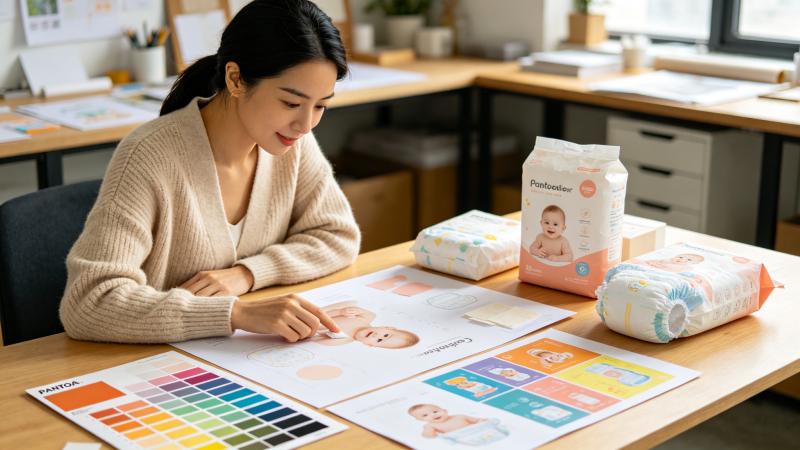
Packaging is the first physical touchpoint between a diaper brand and its customer. On a retail shelf or in an online unboxing, the packaging communicates brand identity, product quality, and key purchasing decisions before a parent ever touches a diaper. For private label brands launching through a custom printed baby diapers manufacturer in China, packaging design is where brand strategy becomes a tangible, shippable product. Getting it right requires coordinating structural design, graphic layout, regulatory compliance, and manufacturing feasibility — often across time zones and language barriers.
This article is part of our cluster on custom printed baby diapers manufacturer in China.
Diaper Packaging Structures: Choosing the Right Format
The first decision in packaging design is the structural format. Each format has different cost profiles, shelf presence, convenience features, and manufacturing requirements.
Resealable Poly Bags (Standard)
Resealable poly bags are the most common diaper packaging format worldwide, used by both premium and value brands. A typical bag holds 20-80 diapers (depending on size) and features a resealable adhesive tape or zipper closure at the top, a carry handle, and a tear notch for easy opening. Bags are lightweight, cost-effective, and offer full-surface printing. They are produced on form-fill-seal (FFS) machines or made from pre-made laminated films. MOQ for custom-printed bags is typically 5,000-20,000 units, and unit cost ranges from $0.02 to $0.08 per bag depending on size, material, and finish.
Cardboard Cartons (Premium)
Cardboard cartons — either folding cartons or corrugated boxes — are used by premium and eco-focused brands that want a more substantial shelf presence and better product protection. Cartons typically hold 40-120 diapers and may include a resealable inner bag or a plastic tray. Cartons offer excellent print quality (offset or flexographic printing on coated paperboard), premium finishes (embossing, foil stamping, spot UV), and are more recyclable than plastic bags. However, they are more expensive ($0.10-$0.30 per unit), heavier (increasing shipping costs), and require additional assembly labor. MOQ for custom cartons is typically 3,000-10,000 units.
Plastic Canisters or Tubs (Niche)
Plastic canisters or tubs are used primarily for baby wipes, but some premium diaper brands use them for newborn or travel-size packs. They offer a premium feel, easy one-handed dispensing, and are reusable. However, they are expensive ($0.50-$2.00 per unit), require custom injection molds ($5,000-$20,000), and are less common for diapers. Most brands reserve canisters for wipes or limited-edition gift packs.
Bundle and Multipack Formats
For club stores (Costco, Sam's Club) and bulk online retailers, diapers are often packaged in multipacks: two or four standard bags bundled in shrink wrap or a cardboard sleeve. Multipack packaging requires a separate outer design that reinforces brand identity while allowing the inner bags to remain visible. MOQ for multipack outer packaging is typically tied to the inner bag MOQ and adds $0.05-$0.15 per multipack unit.
Graphic Design Principles for Diaper Packaging
Effective diaper packaging design balances brand identity, product communication, and regulatory requirements within a limited surface area. These principles guide successful private label diaper packaging.
Front Panel Hierarchy
The front panel of a diaper package should communicate four things in order of visual priority: brand name and logo, product type and size, key benefit claims, and quantity. The brand logo should occupy 15-25% of the front panel area and be positioned in the upper third for optimal shelf visibility. Product size (NB, S, M, L, XL) should be immediately recognizable — many brands use a color-coded size system where each size has a distinct accent color. Key benefits (e.g., "12-Hour Leak Protection," "Hypoallergenic," "Plant-Based") should be limited to 2-3 claims to avoid visual clutter. Quantity should be clearly displayed in the lower right or lower left corner.
Color Strategy
Color is the most powerful brand recognition tool on a retail shelf. Successful diaper brands use a consistent base color (or color family) across all sizes, with size-specific accent colors for easy differentiation. For example, a brand might use soft teal as the base color for all sizes, with pink accents for newborn, blue for small, green for medium, and orange for large. When defining packaging colors, specify both the packaging print colors and the diaper backsheet print colors to ensure coordination. Use Pantone Solid Coated values for critical brand colors, and request physical color proofs on the actual packaging material before mass production.
Imagery and Illustration Style
Diaper packaging typically uses one of three visual approaches: baby photography (warm, emotional, lifestyle-focused), character illustration (cute animals, patterns, brand mascots), or abstract pattern design (geometric, organic, minimalist). Each approach appeals to a different market segment. Baby photography works well for premium and emotional brands but requires high-quality, diverse imagery and can look dated quickly. Character illustration is popular for mid-tier and value brands and allows for coordinated diaper backsheet patterns. Abstract pattern design is used by minimalist and eco-focused brands and ages well. Whichever approach you choose, ensure the imagery is consistent across packaging, diaper print, marketing materials, and digital touchpoints.
Typography
Use no more than two typefaces on diaper packaging: a display font for brand name and headlines, and a sans-serif body font for product information, claims, and regulatory text. The brand name should use a font that reflects your brand personality (rounded and friendly for value brands, elegant and refined for premium, bold and modern for eco-focused). Body text should be clean, legible at small sizes, and support all languages required for your target markets. Specify font sizes for each element: brand name (18-36pt depending on package size), product name (12-18pt), claims (10-14pt), regulatory text (6-8pt minimum for regulatory compliance).
Regulatory Labeling Requirements
Diaper packaging must comply with labeling regulations in every market where the product is sold. Non-compliance can result in product recalls, import detentions, fines, and reputational damage. These are the key labeling requirements for major markets.
United States
In the US, diaper packaging must include: product identity (e.g., "Disposable Baby Diapers"), net quantity (count and/or weight), manufacturer or distributor name and address, material composition (if claimed), and any safety warnings (e.g., "To avoid risk of suffocation, keep this plastic bag away from babies and children"). If making claims such as "hypoallergenic," "chlorine-free," or "biodegradable," ensure you have substantiation and that the claims comply with FTC guidelines. Country of origin labeling ("Made in China") is required for imported products.
European Union
In the EU, diaper packaging must include: product name, net quantity, manufacturer or importer name and address (within the EU), country of origin, use instructions, and safety warnings. If the product is classified as a medical device (some diapers for incontinence or medical use are), additional CE marking and notified body information may be required. Packaging must comply with the EU Packaging and Packaging Waste Directive (94/62/EC) for heavy metal limits (cadmium, lead, mercury, hexavalent chromium <100 ppm total) and the REACH regulation for restricted substances. Language requirements vary by country — products sold in multiple EU countries may need multilingual labeling.
Other Markets
Australia and New Zealand require product name, net quantity, supplier name and address, and country of origin, with additional requirements for baby products under the Australian Consumer Law. Canada requires bilingual (English/French) labeling for most products, including product identity, net quantity, dealer name and address, and safety warnings. Middle Eastern markets (GCC) require Arabic language labeling, Halal certification if applicable, and compliance with GCC standardization organization requirements. Southeast Asian markets (Indonesia, Vietnam, Philippines, Thailand) each have their own labeling requirements, including local language labels and import registration numbers.
Required Labeling Elements Checklist
Ensure your packaging design includes space for all of the following: product name/identity, brand name, size indicator (NB/S/M/L/XL), count/quantity, manufacturer or importer name and address, country of origin, material composition (if making claims), use instructions, safety warnings (suffocation warning for plastic bags), barcode (UPC/EAN), batch/lot code area, expiration or production date area, recycling symbols (where required), and any certification marks (CE, FDA, ISO, dermatologically tested, etc.).
Sustainable Packaging Options
Sustainability is an increasingly important purchasing factor for diaper buyers, and packaging is the most visible sustainability signal. These options range from easy-to-implement to more complex and costly.
Recyclable Materials
Standard poly bags made from polyethylene (PE) are technically recyclable but are rarely accepted in curbside recycling programs because they jam sorting equipment. Using monomaterial PE (rather than laminated PE/PET or PE/ALU) makes bags more recyclable through store drop-off programs. Cardboard cartons are widely recyclable in curbside programs and are preferred by eco-focused consumers. Some brands use recycled content (PCR — post-consumer recycled) in packaging materials, though PCR availability and quality can vary.
Reduced Plastic Content
Downsizing packaging (using less material per unit), reducing overpackaging (eliminating unnecessary outer sleeves or inserts), and using thinner gauge films (where structural integrity allows) all reduce plastic content. Some brands have switched from plastic bags to paper-based packaging or hybrid paper/plastic formats, though these can compromise moisture barrier and product protection.
Compostable and Biobased Materials
Compostable packaging materials (PLA, PHA, starch-based blends) are available but have significant limitations for diapers: they may not provide adequate moisture barrier, they require industrial composting facilities (not available in most markets), and they can be 2-5 times more expensive than conventional PE. Biobased PE (made from sugarcane or other renewable feedstocks) is chemically identical to fossil-based PE, fully recyclable, and reduces carbon footprint by 60-80%, but costs 15-30% more. Most brands focus on recyclable monomaterial and reduced plastic content rather than compostable alternatives for diaper packaging.
Packaging Messaging
If making sustainability claims on packaging, ensure they are accurate and compliant with green marketing guidelines (FTC Green Guides in the US, EU Green Claims Directive). Avoid vague claims like "eco-friendly" or "green" without specific substantiation. Use specific, verifiable claims: "Packaging made with 30% recycled plastic," "Recyclable through store drop-off programs," or "Carbon-neutral shipping." Third-party certifications (FSC for paper, ISCC PLUS for biobased content, Recycled Claim Standard for PCR) add credibility.
Packaging Finishes and Enhancements
Finishes and enhancements elevate perceived quality and differentiate premium brands from value competitors. These options add cost but can significantly improve shelf impact and unboxing experience.
Matte vs. gloss lamination. Gloss lamination is standard for poly bags and produces a shiny, vibrant surface. Matte lamination produces a soft, non-reflective surface that conveys premium quality and reduces fingerprint visibility. Matte is typically 10-20% more expensive than gloss and is used by premium and eco-focused brands.
Soft-touch coating. Soft-touch (or velvet-touch) coating produces a tactile, velvety surface that feels luxurious. It is used on premium cartons and some high-end poly bags. Soft-touch coating adds $0.03-$0.08 per unit and can show fingerprints and scuffs more easily than matte or gloss.
Spot UV and varnish. Spot UV applies a glossy, raised varnish to specific areas of the packaging (typically the logo, product name, or key design elements), creating contrast against a matte background. It draws attention to brand elements and adds a premium feel. Spot UV adds $0.02-$0.05 per unit and requires additional plate making.
Foil stamping and embossing. Foil stamping (gold, silver, holographic, or custom color foil) and embossing (raised or debossed design elements) are premium enhancements used on luxury and gift-pack diapers. They add significant cost ($0.05-$0.20 per unit), require custom tooling, and are typically only viable for cartons (not poly bags). Most mass-market diaper brands avoid these enhancements due to cost.
Window patches. Die-cut window patches (with clear film) allow consumers to see the diaper product inside the packaging. Windows are common on cartons and some premium bags, adding transparency and product visibility. Window patches add $0.02-$0.05 per unit and require additional die-cutting and film application.
Coordinating Packaging and Diaper Print
A cohesive brand experience requires coordination between packaging design and diaper backsheet/waistband printing. When both are produced by the same manufacturer, coordination is simpler; when packaging is sourced separately, additional effort is required.
Color consistency across substrates. The same brand color may print differently on poly bag film, paperboard carton, and diaper backsheet PE film due to differences in substrate absorbency, surface texture, and ink type. Request color proofs on each substrate and approve them as a set, not individually. If exact color matching is critical, consider using a single print method (e.g., flexographic) for both packaging and diaper print, or specify a wider Delta E tolerance for cross-substrate matching.
Design element coordination. Repeating patterns, characters, or motifs from the diaper backsheet can be echoed on the packaging for a cohesive brand experience. For example, a brand with animal illustrations on the diaper backsheet might feature the same animals on the packaging front panel. This coordination requires the packaging designer and diaper print designer to work from the same brand asset library.
Single-source advantage. Working with a manufacturer that offers both custom diaper printing and custom packaging design/production simplifies coordination, reduces lead times, and ensures consistent quality. New Yifa Group offers in-house packaging design and production alongside diaper printing and converting, allowing brands to manage both through a single point of contact. Learn more about our private label services.
Packaging Design Workflow with a China Manufacturer
Understanding the standard workflow helps brand owners plan timelines and avoid delays.
Step 1 — Design brief and asset transfer (1-3 days). You provide your brand guidelines, design files (AI, PDF, or PSD), packaging structure specifications, and target market regulatory requirements. The manufacturer's design team reviews the brief and confirms feasibility.
Step 2 — Design adaptation and digital proof (3-7 days). The manufacturer adapts your design for the specific packaging structure and print method, adds required regulatory elements (barcode, batch code area, warnings), and provides a digital proof (PDF) for your review and approval. This is the stage to make design changes — changes after physical sample approval incur additional costs.
Step 3 — Physical sample (5-10 days). The manufacturer produces a physical packaging sample using the actual material and print method, filled with representative product weight. You evaluate the sample for color accuracy, structural integrity, print quality, and overall brand presentation. Most manufacturers include 1-2 rounds of sample revisions in the standard price.
Step 4 — Mass production (10-20 days). With sample approval, packaging production begins. For poly bags, this involves film extrusion/lamination, printing, and bag conversion. For cartons, it involves paperboard printing, die-cutting, and gluing. Quality inspection includes color checks, structural integrity tests, and print defect inspection.
Step 5 — Integration with diaper production (3-7 days). Finished packaging is delivered to the diaper converting line (if in-house) or shipped to the diaper manufacturer (if packaging is sourced separately). Diapers are packed into the custom packaging, cartons are labeled, and finished goods are prepared for shipment.
Frequently Asked Questions
What is the minimum order for custom diaper packaging?
For custom-printed resealable poly bags, MOQ is typically 5,000-20,000 units per design. For cardboard cartons, MOQ is 3,000-10,000 units. Some manufacturers offer lower MOQs (1,000-3,000) for first-time partners or for premium cartons, but expect higher unit costs for small runs.
How much does custom diaper packaging cost?
Custom-printed resealable poly bags cost $0.02-$0.08 per unit depending on size, material thickness, number of colors, and finish. Cardboard cartons cost $0.10-$0.30 per unit. Premium finishes (matte lamination, spot UV, soft-touch) add $0.02-$0.08 per unit. Tooling and setup costs (printing plates, cutting dies) add $300-$1,500 per design, typically one-time.
Can I use my own packaging designer and have the manufacturer print it?
Yes. Most manufacturers accept print-ready design files from external designers. However, ensure your designer follows the manufacturer's specifications: correct file format (AI, PDF with embedded fonts), correct dimensions with bleed (typically 3mm), CMYK color mode (not RGB), outlined text, and correct dieline template. The manufacturer will review the files for print feasibility and may request minor adjustments.
What regulatory information must appear on diaper packaging?
Required information varies by market but typically includes: product name, net quantity (count), manufacturer or importer name and address, country of origin, size indicator, use instructions, safety warnings (suffocation warning for plastic bags), barcode, batch/lot code area, and material composition if making claims. The US requires FTC-compliant labeling; the EU requires multilingual labeling and compliance with Packaging Directive and REACH; Canada requires bilingual English/French labeling.
How long does custom packaging production take?
The full timeline from design submission to finished packaging is typically 20-40 days: 3-7 days for design adaptation and digital proof, 5-10 days for physical sample, 10-20 days for mass production, and 3-7 days for integration with diaper packing. If packaging is sourced from a separate supplier, add shipping time (3-7 days by air, 15-25 days by sea) and coordination time.
Should I choose plastic bags or cardboard cartons?
Plastic bags are lighter, cheaper, and offer good moisture protection, making them ideal for value and mid-tier brands and for online sales. Cardboard cartons offer better shelf presence, higher perceived quality, and are more recyclable, making them ideal for premium brands, gift packs, and retail shelf sales. Consider your target retail channel, price point, brand positioning, and sustainability goals when choosing. Some brands use bags for everyday sizes and cartons for newborn or premium lines.
Conclusion
Custom diaper packaging is where brand strategy becomes a tangible product on a retail shelf. Successful private label packaging balances structural functionality, compelling graphic design, regulatory compliance, and manufacturing feasibility — all while coordinating with diaper backsheet print for a cohesive brand experience. By choosing a manufacturer with in-house packaging design and production capability, defining clear brand guidelines and regulatory requirements, and following a structured design-approval-production workflow, brand owners can launch packaging that stands out on the shelf and builds lasting brand recognition.
← Back to Custom Printed Baby Diapers Manufacturer Guide | Next: Waistband & Frontal Tape Custom Printing →