
7-factor framework for evaluating China diaper factories for brand partnership. Covers capacity, certifications, R&D, quality control, MOQ, pricing and communication fit.
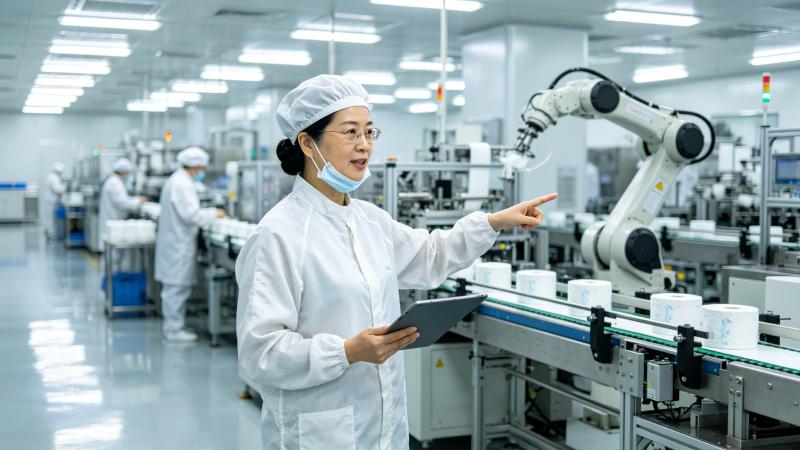
Choosing the wrong diaper factory is the single most expensive mistake a distributor can make. A factory that cuts corners on SAP content, uses substandard pulp, or lacks quality control will cost you in product returns, consumer complaints, regulatory penalties, and — worst of all — reputational damage that takes years to repair. This guide gives you a systematic, 7-dimension framework for evaluating Chinese diaper manufacturers, plus a printable audit checklist and a list of red flags that should immediately disqualify a candidate.
This is a companion to our complete guide to becoming a diaper distributor through a China factory brand partnership. Read that first for strategic context; use this article for the tactical vetting process.
First: Distinguish Real Manufacturers from Trading Companies
Before evaluating any factory's capabilities, confirm it is actually a manufacturer. Roughly 40% of "diaper factories" you find on B2B platforms are trading companies or agents who buy from real factories and mark up the price. Working with a trading company is not always wrong — they can provide valuable logistics and communication services — but you should know what you are paying for and you should never pay a trading company's markup when you could work directly with the factory.
| Indicator | Real Manufacturer | Trading Company |
|---|---|---|
| Company name on business license | Includes "Manufacturing," "Industrial," "Hygiene Products Co., Ltd." | Includes "Trading," "Import & Export," "Commerce," "International" |
| Registered address | Industrial zone, factory building with production area | Office building, commercial complex, residential address |
| Production equipment | Owns production lines; can provide equipment list and photos | No production equipment; office-only location |
| Customization depth | Can adjust SAP content, core structure, material grades per spec | Limited to existing factory catalog; slow to answer technical questions |
| Sample lead time | 7–15 days for custom samples | 3–7 days (sending existing stock samples) or 20+ days (forwarding to factory) |
| Pricing flexibility | Can quote FOB directly; transparent cost breakdown | Prices 10–25% higher; reluctant to share cost structure |
Verification method: Request a copy of the business license (营业执照), check the registered scope and address, then ask for a live video tour of the factory. A real manufacturer will happily show you the production floor, raw material warehouse, finished goods warehouse, QC lab, and packaging area. A trading company will make excuses, show you only an office, or arrange a visit to a "partner factory" where you cannot verify who actually owns the equipment.
The 7-Dimension Factory Evaluation Framework
Once you have confirmed you are dealing with real manufacturers, evaluate each candidate on these seven dimensions. Score each 1–5; any dimension scoring below 3 is a disqualifier.
Dimension 1: Production Capacity and Scale
A factory's capacity determines whether it can meet your current needs and — critically — scale with you as your distribution business grows. Key questions:
- How many automated production lines does the factory operate? What type (full-servo, semi-servo, mechanical)? Full-servo lines produce more consistent quality at higher speeds (350–500 pieces/minute).
- What is the monthly and annual production capacity? A factory with fewer than 3 lines may struggle to deliver orders above one container per month without delaying other customers.
- What is the factory's current capacity utilization? If they are running at 95%+, your orders may be deprioritized during peak season (September–November for year-end retail stocking).
- Does the factory have expansion plans? New Yifa Group's 68 automated production lines with monthly capacity of 98 million pieces provide ample room for distributor growth.
Dimension 2: Quality Management System and Certifications
Certifications are not decorations — they are evidence that a factory has documented processes, trained personnel, and external accountability. Minimum and recommended certifications:
- ISO 9001 (Quality Management System) — minimum requirement. Verify the certificate is current and covers diaper manufacturing specifically.
- ISO 13485 (Medical Device Quality Management System) — strongly recommended. For hygiene products, ISO 13485 carries more weight than ISO 9001 because it imposes stricter controls on traceability, risk management, and regulatory compliance [ISO.org].
- CE marking — required for access to the European Economic Area. The factory should have a valid CE certificate and technical file.
- FDA registration — required if you plan to sell in the US market, especially if diapers are marketed as medical devices.
- Third-party test reports — current (within 12 months) reports from SGS, Intertek, TÜV Rheinland, or Bureau Veritas covering absorption performance, pH, heavy metals, microbiology, and skin safety.
- Additional market-specific certifications — Halal (Muslim markets), OEKO-TEX Standard 100 (textile safety), FSC (responsible pulp sourcing), ISO 14001 (environmental management), ISO 45001 (occupational health and safety).
Red flag: A factory that shows you certificate images but cannot provide PDF copies, or whose certificates have expired or were issued by an unrecognized accreditation body. Always verify certificate numbers with the issuing organization.
Dimension 3: Raw Material Sourcing and Transparency
Diaper quality is determined primarily by raw materials. A factory that is transparent about its material suppliers is more likely to use consistent, high-quality inputs. Ask for:
- SAP (super absorbent polymer) brand and grade. Premium SAP comes from BASF, Evonik, Sumitomo, or LG Chem. Domestic Chinese SAP (e.g., from Wanhu, DNP, or Satellite) has improved significantly and is suitable for mid-market products, but you should know which is being used.
- Fluff pulp origin and grade. Northern bleached softwood kraft (NBSK) from Scandinavia (Stora Enso, UPM, Metsä) or Canada provides longer fibers and better core integrity. Recycled pulp is cheaper but may have higher impurity levels and lower absorption speed.
- Non-woven fabric type and supplier. Hot-air (through-air) non-woven is softer and more breathable than spunbond. 3D embossed or pearl-pattern topsheets improve liquid acquisition and reduce skin contact area.
- Adhesive and elastic suppliers. Hot-melt adhesives from Henkel, Bostik, or H.B. Fuller are industry standards. Elastic strands from Lycra (Invista) or equivalent provide consistent stretch recovery.
- Raw material safety stock. Does the factory maintain 2–4 weeks of inventory for critical materials? This protects your lead times during supply disruptions (e.g., the 2021–2022 global pulp shortage).
Dimension 4: OEM/ODM and Customization Capability
If you are building your own brand, the factory's ability to customize is critical. Evaluate:
- Product customization range. Can they adjust SAP content per size (e.g., 8g for NB, 14g for L)? Offer multiple topsheet options (plain, pearl, 3D hot-air, bamboo)? Provide wetness indicators, 360° elastic waistbands, aloe/chamomile lotion, or biodegradable materials?
- Packaging customization. Do they have in-house graphic design? Can they produce custom bag designs, resealable packaging, handle bags, or carton configurations? What are the packaging MOQ and plate fees?
- R&D capability. Does the factory have an in-house R&D team and lab? How many patents do they hold? How quickly can they develop a custom sample (target: 7–15 days)? New Yifa's 1,200m² R&D center with 60+ patents is a strong indicator of innovation capability.
- New product development process. Is there a structured NPD process with spec sheets, prototype iterations, lab testing, and pilot production runs? Or do they just "try to make it" on the production line?
Dimension 5: Export Experience and Market Knowledge
A factory that has exported to your target market understands its regulatory requirements, labeling standards, packaging language needs, and consumer preferences. Ask:
- How many countries do they currently export to? Can they provide a list (without confidential customer names)?
- Do they have experience with your specific market's regulations? For example: EU REACH and CE, US FDA and CPSIA, Russia EAC and state registration, Indonesia SNI, Saudi Arabia SFDA, Brazil ANVISA.
- Can they provide labeling templates compliant with your market's requirements (local language, ingredient disclosure, manufacturer information, batch coding, expiration date format)?
- Do they have references from distributors in your region or a similar market? A 5–10 minute call with an existing distributor in your region will tell you more about the factory's reliability than any marketing material.
Dimension 6: Communication and Project Management
Fast, accurate, and professional communication is a leading indicator of operational quality. Evaluate during your initial interactions:
- Response time. Do they reply to emails within 24 hours (or 12 hours during your overlapping working hours)? Slow responses during the sales phase usually get worse after you place an order.
- Language capability. Is there a dedicated English-speaking (or your-language-speaking) sales or project manager? Do they understand technical terminology (SAP loading, rewet, acquisition layer, FOB, MOQ) without confusion?
- Documentation quality. Are quotes, spec sheets, and proforma invoices clear, detailed, and professional? Or are they vague, inconsistent, and full of errors?
- Proactive communication. Do they flag potential issues (raw material delays, production scheduling conflicts, shipping space shortages) before they become crises? Or do you only hear from them when you chase?
- After-sales support. What happens if you receive defective goods? Do they have a clear claims process, replacement policy, and technical support for product issues?
Dimension 7: Price Competitiveness (Evaluated Last)
Price should be the final filter, not the first. Once you have narrowed to 2–3 factories that pass dimensions 1–6, compare quotes for an identical specification. When comparing quotes:
- Ensure all quotes are for the same incoterm (FOB Xiamen is standard for Fujian factories).
- Check whether packaging, labeling, and export documentation are included or charged separately.
- Compare per-unit price at the same order quantity (factories often give tiered pricing — a quote for 1 container is not comparable to a quote for 5 containers).
- Calculate total landed cost, not just FOB price. A factory with a slightly higher FOB price but lower defect rates, faster lead times, and better communication may have a lower total cost of ownership.
- Be suspicious of quotes that are 15%+ below the median. In diaper manufacturing, there is very little margin to cut without reducing material quality. The most common "savings" come from reducing SAP content (e.g., from 12g to 9g per size L), using cheaper pulp grade, or substituting premium non-woven with lower-grade material.
On-Site Factory Audit Checklist
If you visit the factory in person (recommended for orders above $50,000 or exclusive partnerships), use this checklist:
Production Floor
- □ Count production lines and verify they match the factory's claims
- □ Check line speed (pieces per minute) and automation level
- □ Observe raw material loading — are SAP and pulp brands as claimed?
- □ Check in-line quality inspection — vision systems, metal detectors, weight checks
- □ Observe worker hygiene — uniforms, hairnets, gloves, handwashing stations
- □ Check workshop cleanliness — dust-free/cleanroom certification, air filtration, floor condition
Raw Material and Finished Goods Warehouses
- □ Verify raw material inventory levels and storage conditions (temperature, humidity)
- □ Check material labeling and traceability (batch numbers, supplier identification)
- □ Verify finished goods inventory and FIFO (first-in-first-out) rotation
- □ Check packaging material storage and plate/printing quality
Quality Control Lab
- □ Check testing equipment: absorption tester, rewet tester, tensile tester, pH meter, microbiological incubator
- □ Review testing records — are they complete, current, and consistent?
- □ Verify calibration certificates for testing equipment
- □ Check retained sample storage (factories should retain samples from each batch for 6–12 months)
Management and Documentation
- □ Review ISO certificates and recent audit reports (internal and external)
- □ Check customer complaint handling process and records
- □ Verify export documentation capability (commercial invoice, packing list, bill of lading, certificate of origin, phytosanitary/health certificate if required)
- □ Meet the production manager and QC manager — assess their knowledge and professionalism
Red Flags: Disqualify Immediately
- Cannot provide a business license or factory address.
- Refuses video factory tour or on-site visit.
- Certificates are expired, forged, or from unrecognized bodies.
- Quote is 15%+ below comparable factories without a clear cost explanation.
- Cannot or will not disclose raw material suppliers.
- Communication is consistently slow or vague after initial contact.
- Demands 100% payment upfront or refuses third-party pre-shipment inspection.
- Has no export experience or cannot provide any customer references.
- Samples show inconsistent quality between batches or between sample and spec.
- Factory has a history of product recalls, regulatory violations, or customer disputes (search the company name + "recall," "lawsuit," "complaint" in both English and Chinese).
Why Fujian Manufacturers Stand Out
Among China's three major diaper manufacturing clusters (Fujian Putian–Quanzhou, Guangdong Foshan–Dongguan, Yangtze River Delta), Fujian offers the strongest combination for export-oriented distributors:
- Export DNA: Fujian factories have focused on export since the early 2000s and understand international requirements intuitively.
- Scale and automation: The cluster hosts some of China's largest diaper factories, with 50+ production lines in a single facility not uncommon.
- Vertical integration: SAP, non-woven, PE film, elastic, and packaging are all sourced within 30–50km, reducing lead times and customization friction.
- Brand-building experience: Several Fujian manufacturers have built successful international brands (e.g., New Yifa's PALMBABY in Russia), giving them brand-level product and packaging expertise that pure OEM factories lack.
New Yifa Group, headquartered in Putian, Fujian, embodies these advantages: 32 years of experience, 68 automated lines, double 100,000-level purification workshops, full certification portfolio, and exports to 88+ countries. We welcome factory visits and third-party audits — contact us to schedule a visit or request a detailed factory profile.
Frequently Asked Questions
Q: How many factories should I evaluate before choosing?
A: Shortlist 5–8, request samples from 3–4, and conduct detailed evaluation (including factory visit or third-party audit) on 2 finalists. Choosing between 2 qualified factories gives you negotiating leverage and a backup option.
Q: Is a factory audit necessary if the factory has good certifications?
A: Certifications verify that processes are documented; an audit verifies that processes are actually followed. For orders above $50,000 or exclusive partnerships, an on-site visit or third-party audit (cost: $300–$800 per man-day) is strongly recommended. The cost is trivial compared to the risk of partnering with a substandard factory.
Q: Can I switch factories later if I am not satisfied?
A: Yes, but switching is costly. You will need to re-develop samples, re-validate quality, potentially re-register products in your market, and accept a gap in supply. It is far better to invest time in selecting the right factory upfront than to switch after 1–2 orders.
Summary
Choose a China diaper factory by first confirming it is a real manufacturer (not a trading company), then evaluating 7 dimensions: production capacity, quality certifications, raw material transparency, OEM/ODM capability, export experience, communication, and price (evaluated last). Conduct an on-site audit or third-party inspection for significant orders. Disqualify factories with expired certificates, refusal of factory visits, unexplained low pricing, or poor communication. Fujian's Putian cluster offers the strongest export-oriented manufacturing ecosystem.
← Back to Complete Diaper Distributor Guide | Next: Diaper Quality Standards to Verify →
Evaluate New Yifa Group as Your Factory Partner
Request our factory profile, certification portfolio, and free customized samples.