
Step-by-step guide to starting a baby diaper distribution business. Covers market research, supplier selection, MOQ, pricing strategy, legal setup and first-order execution.
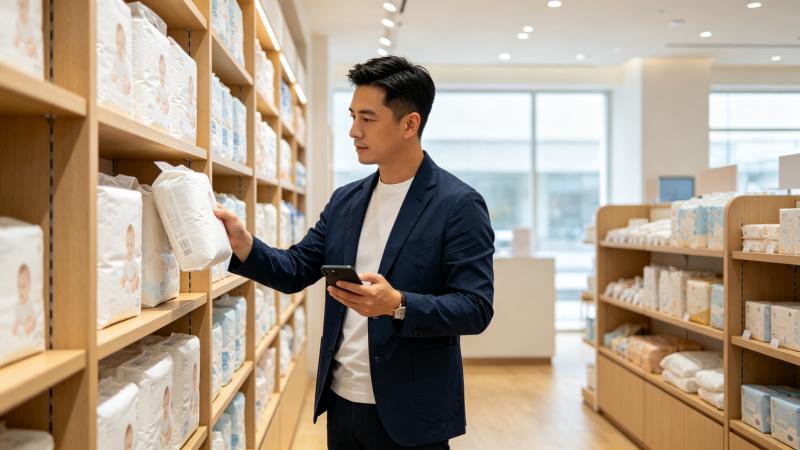
Starting a baby diaper distribution business is different from launching most consumer product categories. Diapers are bulky, regulated, high-volume, and consumed on a predictable schedule — which means the business rewards operational discipline more than marketing cleverness. This guide walks you through every stage, from initial market research to receiving your first container, based on patterns observed across hundreds of distributor partnerships in 88+ countries.
If you have not yet read our complete guide to becoming a diaper distributor through a China factory brand partnership, start there for the strategic overview. This article focuses on the tactical steps of launching.
Phase 1: Market Research and Validation (Weeks 1–4)
Before registering a company or contacting factories, you need to answer one question with data: is there a profitable gap in your market for the diaper product you plan to sell?
1.1 Analyze Your Target Market
Gather the following data for your country or region:
- Birth rate and population of children 0–3. This is your addressable consumer base. Multiply by average daily diaper usage (6–10) and average days in diaper (700–900) to estimate annual unit demand.
- Current market size and growth rate. Research reports from Euromonitor, Grand View Research, or local market research firms can provide baseline data. The global baby diaper market grows at roughly 5% CAGR, but emerging markets often grow 8–12% [source].
- Competitive landscape. Visit retail stores and e-commerce platforms in your market. List the top 10 diaper brands by shelf presence or online ranking. Note their price points, pack sizes, claimed features (ultra-thin, 12-hour dryness, organic, wetness indicator), and packaging quality.
- Price tier gaps. Plot competitors on a price-per-diaper axis. Look for gaps — for example, if all premium brands cost $0.35+/diaper and all economy brands are below $0.15, there may be room for a mid-market quality product at $0.20–$0.25.
- Consumer pain points. Read online reviews of top brands. Common complaints include leakage, diaper rash, poor fit, slow absorption, and packaging that is hard to open. These pain points are your product differentiation opportunities.
1.2 Define Your Customer and Channel
Diaper distributors typically serve one or more of these customer segments:
| Channel | Characteristics | Margin |
|---|---|---|
| Mother-baby specialty stores | Knowledgeable staff, premium product focus, loyal customer base | 35–50% |
| Pharmacy chains | Trust-driven, health-focused, requires product registration in many countries | 30–45% |
| Supermarkets/hypermarkets | High volume, slotting fees, strict payment terms, strong private-label presence | 20–35% |
| E-commerce marketplaces | Direct-to-consumer, data-rich, high customer acquisition cost, fast feedback loop | 40–60% |
| Wholesale/distributor networks | You sell to regional sub-distributors who serve smaller retailers; fastest geographic coverage | 20–30% |
Most successful first-time distributors start with 1–2 channels where they have existing relationships or domain expertise, then expand. Trying to serve all channels simultaneously spreads your inventory and marketing too thin.
Phase 2: Business Setup and Legal Compliance (Weeks 3–8)
2.1 Register Your Business
Register a business entity (LLC, Ltd., or local equivalent) with a business scope that includes import/export, wholesale distribution, and baby/mother care products. Open a corporate bank account capable of international wire transfers (T/T) and, if possible, letters of credit.
2.2 Obtain Import Licenses and Product Registrations
Requirements vary dramatically by country, but common requirements include:
- Import/export license or customs broker registration
- Product registration or notification — some countries (Russia/EAEU, Indonesia, Saudi Arabia) require diapers to be registered with a health or standards body before import
- Labeling compliance — local language labeling, ingredient disclosure, manufacturer information, batch number, expiration date, size/weight guidance
- Tax registration — VAT/GST/sales tax registration for wholesale and retail sales
Engage a local customs broker and regulatory consultant before placing your first order. The cost of non-compliance — customs detention, product destruction, or import bans — far exceeds the cost of professional advice.
2.3 Arrange Working Capital
Plan your capital needs in three buckets:
- Product and logistics capital (one container): $25,000–$60,000 depending on product specification, incoterms, and destination. This covers the 30% factory deposit, 70% balance before shipment, ocean freight, insurance, import duties, customs clearance, and inland transport to your warehouse.
- Operating capital (3 months): $10,000–$25,000 for warehouse rent, staff, marketing, samples, travel, and unplanned expenses.
- Buffer capital: $5,000–$15,000 for unexpected costs — shipping delays, customs inspections, exchange rate fluctuations, or initial promotional discounts to secure retail listings.
Total startup capital typically ranges from $40,000 to $100,000. Under-capitalization is the second most common reason new diaper distributors fail (after product quality issues). Do not commit your last dollar to the first order — maintain a reserve.
Phase 3: Sourcing and Factory Selection (Weeks 6–12)
With your market research and business setup underway, begin sourcing. The process is:
- Create a product specification sheet. Based on your market research, define diaper type (tape or pull-up), size range, target SAP content, topsheet material, backsheet type, features (wetness indicator, 360° elastic waistband, aloe/chamomile lotion), pack counts, and packaging design direction.
- Source and shortlist 5–8 factories. Use Alibaba, Made-in-China.com, Global Sources, Canton Fair, CBME, and referrals. Prioritize factories in the Fujian Putian–Quanzhou cluster for export experience and scale.
- Evaluate against the 7-dimension framework. Manufacturing authenticity, certifications, raw material transparency, OEM/ODM capability, export experience, communication, and price. We cover this in detail in our guide on how to choose a China diaper factory for brand partnership.
- Request samples from 2–3 finalists. Provide your spec sheet and ask for customized samples. Evaluate absorption speed, rewet, softness, fit, leakage, and packaging quality.
- Conduct factory verification. Visit in person if possible, or arrange a third-party factory audit (SGS, Bureau Veritas, or TÜV Rheinland typically charge $300–$800 for a man-day audit).
- Negotiate and sign a supply agreement. Cover pricing, MOQ, lead time, payment terms, quality standards, inspection protocols, defect replacement, exclusivity (if applicable), and confidentiality.
New Yifa Group offers a streamlined onboarding process for new distributors: private brand cooperation and agency programs, free sample development within 7–15 days, and dedicated project managers who guide first-time importers through every step. Explore our production capabilities and R&D center to understand our capacity.
Phase 4: First Order and Launch (Weeks 10–20)
4.1 Place a Trial Order
For your first order, resist the temptation to maximize volume for a lower per-unit price. Start with one 20ft container or a partial 40HQ if the factory allows. The goal of the first order is to validate:
- Product quality in mass production (not just samples)
- Consumer acceptance and sell-through rate by SKU
- Channel partner willingness to stock your product
- Logistics pipeline reliability (factory → port → shipping → customs → warehouse)
- Accuracy of your cost and margin model
4.2 Secure Pre-Orders or Channel Commitments
Ideally, before your container arrives, you have secured commitments from retail partners or sub-distributors to take a significant portion of the inventory. This reduces warehousing costs and cash-flow pressure. Offer introductory pricing, marketing co-op support, or flexible return terms for first-time listings.
4.3 Plan Marketing and Promotion
For a new diaper brand, the most effective launch activities are:
- In-store sampling and demonstrations in mother-baby stores and pharmacies
- Free sample packs distributed through pediatric clinics, maternity wards, and parenting groups
- Influencer and mommy-blogger reviews on Instagram, TikTok, YouTube, and local platforms
- Promotional pricing for the first 4–8 weeks to drive trial
- Point-of-sale materials — shelf talkers, display stands, posters — that communicate your key differentiators (e.g., "12-hour overnight protection," "dermatologist-tested," "ultra-soft for sensitive skin")
4.4 Monitor and Iterate
Track these metrics weekly during the first 90 days:
- Sell-through rate by size and channel
- Consumer feedback and complaint types (leakage, rash, fit, price)
- Reorder rate from retail partners
- Inventory turnover and days of stock remaining
- Gross margin actual vs. forecast
Use this data to refine your product specification, size mix, pricing, and marketing for the second order. Most distributors find that their second order performs 30–50% better than the first because they have real market data to guide decisions.
Timeline Summary
| Phase | Duration | Key Deliverables |
|---|---|---|
| Market research | 2–4 weeks | Market analysis, competitive matrix, product spec, channel strategy |
| Business setup | 3–6 weeks (overlaps with research) | Company registration, import license, bank account, warehouse |
| Factory sourcing | 4–8 weeks | Shortlist, samples, audit, supply agreement |
| First order production | 4–6 weeks | Deposit, production, pre-shipment inspection |
| Shipping and landing | 3–6 weeks | Ocean freight, customs clearance, warehouse receipt |
| Launch and iteration | Ongoing | Channel listings, marketing, sales tracking, second order |
Total time from decision to first retail sale: 3–5 months.
Frequently Asked Questions
Q: Do I need a warehouse before ordering?
A: Yes, or a third-party logistics (3PL) provider who can receive and store your shipment. Diapers are bulky — one 40HQ container occupies roughly 60–70 cubic meters. Arrange warehouse space before the ship arrives to avoid port storage demurrage charges.
Q: Can I start with e-commerce only, without retail stores?
A: Yes. Many successful distributors start on Amazon, local marketplaces, or their own DTC website. E-commerce requires less upfront channel development but higher marketing spend and faster customer service responsiveness. Plan for 15–25% of revenue for customer acquisition costs in the first year.
Q: What if my first order does not sell?
A: Slow initial sell-through is common. Steps to take: offer promotional pricing to retailers, increase sampling activities, review your product spec against consumer feedback, consider selling excess inventory through discount channels or export to a neighboring market, and adjust your second-order size mix. The key is to not reorder until you understand why the first order is slow.
Summary
Starting a baby diaper distribution business takes 3–5 months and $40,000–$100,000. Validate your market with data, register your business and secure import licenses, source factories using a 7-dimension framework, start with one container, secure channel commitments before landing, and iterate based on real sell-through data. Under-capitalization and poor factory selection are the top two failure modes — avoid both with thorough preparation.
← Back to Complete Diaper Distributor Guide | Next: How to Choose a China Diaper Factory →
Ready to Source Your First Diaper Order?
Request Free Samples & Consultation
New Yifa Group — 68 production lines, 88+ countries, 32 years of diaper manufacturing experience.