
Baby diaper size and fit guide for OEM private label buyers: standard size system, physical dimensions, fit parameters, regional sizing differences, pull-up pants sizing and OEM customization options.
Baby Diaper Size & Fit Guide for OEM Private Label Buyers
For a complete overview of baby diaper OEM and private label options, read our Baby Diaper OEM Guide.
Getting diaper sizing right is one of the most critical factors for private label brand success. A diaper that fits poorly leads to leaks, blowouts, discomfort, and negative reviews — all of which can sink a new brand before it gains traction. For OEM buyers, importers, and private label brand owners, understanding size specifications, fit parameters, and regional sizing differences is essential when sourcing baby diapers from Chinese manufacturers. This guide covers everything you need to know.
1. Why Size and Fit Matter for Private Label Brands
Diaper fit is the number one driver of customer satisfaction and repeat purchase in the baby diaper category. Key reasons sizing must be prioritized:
- Leak prevention: A diaper that is too large gaps at the legs and waist, causing leaks. A diaper that is too small compresses the absorbent core and causes overflow. Proper fit is the primary determinant of leak protection
- Comfort and skin health: Poorly fitting diapers cause red marks, chafing, and pressure points. Extended wear of ill-fitting diapers contributes to diaper dermatitis. Soft, flexible materials with proper fit reduce skin irritation
- Brand perception: First-time buyers who experience leaks or fit issues rarely give a brand a second chance. In competitive markets, a single bad experience can cost a brand hundreds of dollars in lost customer lifetime value
- Review impact: Online reviews frequently mention sizing issues ("runs small," "leaked at night," "left red marks"). Negative reviews about fit directly impact conversion rates and search rankings on Amazon and other e-commerce platforms
- Return and waste costs: Poorly sized diapers lead to higher return rates, customer complaints, and wasted inventory. For private label brands operating on thin margins, these costs can be significant
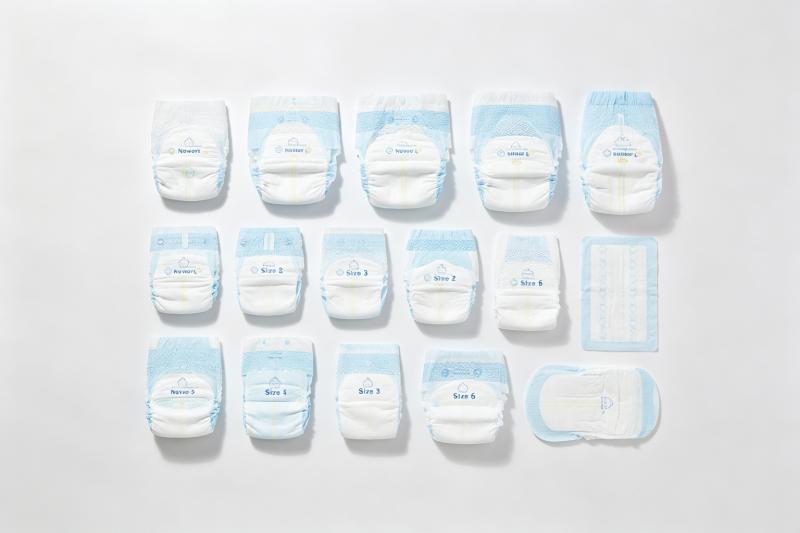
2. Standard Baby Diaper Size System
The global baby diaper market uses a standardized size nomenclature based primarily on baby weight. While exact weight ranges vary slightly by brand and region, the following table represents the most common specifications used by major manufacturers and private label brands:
| Size | Weight Range (lbs) | Weight Range (kg) | Typical Age | Estimated Daily Use |
|---|---|---|---|---|
| Preemie / P | < 6 lbs | < 2.7 kg | Premature / newborn | 8-12 |
| Newborn / NB | 6-10 lbs | 2.7-4.5 kg | 0-1 month | 8-10 |
| Size 1 / S | 8-14 lbs | 3.6-6.4 kg | 1-3 months | 7-9 |
| Size 2 / M | 12-18 lbs | 5.4-8.2 kg | 3-6 months | 6-8 |
| Size 3 / L | 16-28 lbs | 7.3-12.7 kg | 6-12 months | 5-7 |
| Size 4 / XL | 22-37 lbs | 10-16.8 kg | 12-18 months | 5-6 |
| Size 5 / XXL | > 27 lbs | > 12.3 kg | 18+ months | 4-5 |
| Size 6 / XXXL | > 35 lbs | > 15.9 kg | 3+ years / training | 3-4 |
Important note on overlap: Weight ranges intentionally overlap between adjacent sizes. This allows parents to choose based on their baby's body shape, not just weight. A baby with chunky thighs may need to size up before reaching the top of the current weight range, while a lean baby may stay in a size longer than the weight range suggests.
3. Physical Dimensions by Size
Beyond weight ranges, OEM buyers must specify physical dimensions for each size. The following table represents typical dimensions used by Chinese OEM manufacturers for standard tape-style baby diapers:
| Size | Pad Length (mm) | Pad Width (mm) | Waistband (mm) | Leg Opening (mm) | SAP (g) | Core GSM |
|---|---|---|---|---|---|---|
| NB | 330-360 | 240-260 | 320-360 | 180-200 | 4-6 | 180-220 |
| 1 | 380-410 | 260-280 | 360-400 | 200-220 | 6-9 | 200-240 |
| 2 | 430-460 | 280-300 | 400-440 | 220-240 | 8-12 | 220-260 |
| 3 | 480-520 | 300-320 | 440-480 | 240-260 | 10-15 | 240-280 |
| 4 | 530-570 | 320-340 | 480-520 | 260-280 | 12-18 | 260-300 |
| 5 | 580-620 | 340-360 | 520-560 | 280-300 | 15-22 | 280-320 |
| 6 | 620-660 | 360-380 | 560-600 | 300-320 | 18-25 | 300-340 |
Dimensions vary by manufacturer and product positioning. Economy diapers tend to be smaller and thinner with less SAP. Premium diapers are larger, thicker, and have higher SAP loading for better absorbency and fit. Always request dimensional drawings and physical samples from your OEM manufacturer before placing a bulk order.
4. Key Fit Parameters
4.1 Waist Fit
The waistband is the primary fit anchor. Key parameters:
- Waistband stretch: The elastic waistband should stretch 30-50% beyond its relaxed length to accommodate different body sizes and provide a snug, comfortable fit. Too little stretch = gaps and leaks; too much stretch = pressure marks and discomfort
- Waistband height: Front waistband should sit at or just below the baby's belly button. Back waistband should extend slightly higher for back leak protection. NB and Size 1 diapers often feature a cutout or low front waistband to accommodate the umbilical cord stump
- Tape placement: Fastening tapes should be positioned at approximately 45-degree angles when fastened. The tapes should reach the center of the front waistband when the diaper is properly sized. If tapes only reach the edges, the diaper is too small; if tapes overlap significantly in the center, the diaper is too large
- Tape adhesion: Fastening tapes must adhere securely to the front landing zone (landing strip) without damaging the material. Re-fastenable tapes (hook-and-loop or strong adhesive) allow for multiple adjustments, which is important for new parents learning to fit diapers
4.2 Leg Fit
Leg cuffs are the second critical fit element and the most common source of leaks:
- Leg opening circumference: The elastic leg opening should fit snugly around the baby's thigh without leaving deep red marks. A gap of more than 1-2 fingers between the leg cuff and the baby's thigh indicates the diaper is too large and will leak
- Double leg cuffs: Premium diapers feature double leg cuffs (inner barrier cuff + outer standing cuff) for enhanced leak protection. The inner cuff sits against the skin to contain liquid; the outer cuff provides a secondary barrier. Double cuffs are standard in Size 2 and above, and increasingly common in NB and Size 1
- Leg elastic tension: Leg elastics should provide gentle, even tension around the entire leg opening. Too much tension causes red marks and discomfort; too little causes gaps and leaks. Premium diapers use multiple elastic strands (3-5 per leg) for even tension distribution
- Cuff height: Standing leg cuffs should be 20-40mm tall when upright. Taller cuffs provide better leak protection but may be less comfortable for babies with chunky thighs. Always ensure cuffs are pulled upright (not tucked in) when putting on the diaper
4.3 Core Fit and Absorbency Zone
- Core length: The absorbent core should extend from just below the belly button to above the buttocks. A core that is too short leaves gaps at the front or back; a core that is too long bunches and causes discomfort
- Core width: The core should be wide enough to cover the entire crotch area without excessive side material that bunches between the legs. Excessively wide cores can cause hip splaying and discomfort, especially for newborns
- Absorbency zone positioning: SAP distribution should be concentrated in the center and front of the diaper for boys (who urinate forward) and more evenly distributed for girls. Some premium diapers feature gender-specific SAP distribution, but most private label diapers use a unisex distribution that works well for both
- Wetness indicator: Optional feature that changes color when wet, helping parents know when to change the diaper. Common in NB through Size 3. The wetness indicator line should be positioned on the front waistband or core, visible through the top sheet
5. How to Check if a Diaper Fits Properly
OEM buyers should include fit verification in their quality control process. The following checklist can be used to evaluate diaper fit during sample testing:
- Waist check: After fastening, you should be able to slip two fingers comfortably between the waistband and the baby's stomach. If you can fit more than two fingers, the diaper is too loose. If you cannot fit two fingers, the diaper is too tight
- Leg check: Run one finger along the inside of each leg cuff. The cuff should feel snug but not tight. If you can feel a gap, the diaper is too large. If the cuff leaves a deep red mark after wear, the diaper is too small
- Tape check: Fastening tapes should land in the center of the front landing zone at approximately a 45-degree angle. If tapes angle downward (pointing toward the crotch), the diaper is too small. If tapes angle upward (pointing toward the chest), the diaper is too large
- Back check: The back of the diaper should cover the entire buttocks. If the diaper rides low and exposes the buttocks, it is too small or not pulled up high enough
- Movement check: The baby should be able to move legs freely without the diaper shifting or bunching. If the diaper slides to one side or bunches between the legs during movement, the fit is not optimal
- Leak test: After a full wear cycle (3-4 hours), check for leaks at the legs, waist, and back. Any leakage indicates a fit issue (unless the diaper was simply oversaturated beyond its capacity)
- Mark check: After removing the diaper, check for red marks on the skin. Faint marks that disappear within 15 minutes are normal. Deep red marks that persist or cause discomfort indicate the diaper is too tight
6. Regional Sizing Differences
Baby body proportions vary by region and ethnicity, which affects sizing requirements. OEM buyers must consider their target market when specifying diaper dimensions:
| Region | Body Characteristics | Sizing Implications |
|---|---|---|
| East Asia (China, Japan, Korea) | Smaller average birth weight, leaner build, narrower hips | Smaller overall dimensions, narrower core, lower SAP loading. NB and Size 1 have higher market share |
| Southeast Asia (Indonesia, Vietnam, Philippines) | Medium build, average to slightly smaller birth weight | Standard dimensions, moderate SAP. Size 2-4 have highest market share |
| South Asia (India, Pakistan, Bangladesh) | Wide range, many smaller babies, growing middle class with larger babies | Dual sizing strategy: economy line with smaller dimensions, premium line with standard dimensions. High price sensitivity |
| Middle East (GCC, Saudi, UAE) | Larger average birth weight, chunkier build, wider hips | Larger dimensions, wider core, higher SAP loading. Size 3-5 have higher market share. Premium positioning common |
| Africa (Nigeria, Kenya, South Africa) | Wide range, many smaller babies, some larger babies in urban areas | Economy sizing with smaller dimensions and lower SAP for price-sensitive markets. Premium sizing for urban middle class |
| Europe / North America | Larger average birth weight, chunkier build, wider hips | Larger dimensions, wider core, higher SAP loading. Size 3-6 have significant market share. Premium and eco segments strong |
| Latin America (Brazil, Mexico, Argentina) | Medium to large build, average birth weight | Standard to larger dimensions, moderate to high SAP. Size 2-4 have highest market share |
Key takeaway: Never assume a single size specification works for all markets. Work with your OEM manufacturer to adjust dimensions, SAP loading, and core width based on your target market's baby body proportions. Request market-specific samples and conduct fit testing with local babies before launching.
7. Pull-Up Pants Sizing
Pull-up diaper pants (training pants) use a different sizing system than tape-style diapers, as they are designed to be pulled up and down like underwear. Key differences:
| Size | Weight (lbs) | Weight (kg) | Waist (mm, relaxed) | Waist (mm, stretched) | Typical Use |
|---|---|---|---|---|---|
| 4 / L | 22-37 lbs | 10-17 kg | 380-420 | 560-620 | Early potty training, active toddlers |
| 5 / XL | > 27 lbs | > 12 kg | 420-460 | 620-680 | Active toddlers, night training |
| 6 / XXL | > 35 lbs | > 16 kg | 460-500 | 680-740 | Older toddlers, special needs |
| 7 / XXXL | > 41 lbs | > 19 kg | 500-540 | 740-800 | Older children, special needs |
Pull-up pants require a 360-degree elastic waistband that stretches 40-60% for easy pulling up and down while maintaining a snug fit. Leg openings must be stretchy and comfortable for active movement. The absorbent core in pull-up pants is typically shorter and wider than tape diapers, as it needs to accommodate more movement without bunching.
8. OEM Customization Options for Sizing
8.1 Private Label (OEM) Sizing Options
- Choose from manufacturer's standard size library (most common, fastest lead time)
- Adjust dimensions within standard tooling limits (±5-10% on length, width, waist)
- Adjust SAP loading per size (±20% within standard core construction)
- Custom weight range labeling on packaging (must match actual fit performance)
- Typical MOQ: 150,000 pieces per size
- Lead time: 30-45 days after sample approval
8.2 Custom Development (ODM) Sizing Options
- Custom dimensions for all sizes (requires new cutting tools, 4-8 week lead time)
- Custom core construction (airlaid, dual-core, gender-specific SAP distribution)
- Custom elastic configurations (waistband height, leg elastic count, tension)
- Custom tape and landing zone design
- Market-specific sizing profiles (based on target region body data)
- Typical MOQ: 150,000 pieces per size
- Development time: 8-12 weeks (including tooling, samples, and fit testing)
- Lead time: 45-60 days after final approval
8.3 Packaging and Size Assortment
- Pack counts: Newborn (20-40), Size 1-2 (30-60), Size 3-4 (40-80), Size 5-6 (30-60). Larger pack counts offer better per-unit value but higher upfront cost
- Variety packs: Multi-size sample packs for new customers (e.g., NB+1+2 variety pack). Useful for subscription boxes and gift sets
- Size assortment per carton: Standard cartons contain one size. Mixed-size cartons available for distributor and wholesale channels
- Size guide on packaging: Always include a weight-based size guide on the front or back of the packaging. Include fit tips (e.g., "If leaks occur, try the next size up")
9. Common Sizing Mistakes to Avoid
- Copying competitor weight ranges without verifying fit: Competitor weight ranges are marketing claims, not engineering specifications. Always verify that your diaper actually fits babies within the stated weight range through physical fit testing
- Ignoring regional body differences: A size that fits perfectly in China may be too small in the Middle East. Always specify dimensions based on your target market, not the manufacturer's home market
- Overlapping weight ranges that are too wide: While some overlap is normal, excessively wide ranges (e.g., Size 2: 10-20 lbs) confuse parents and lead to poor fit. Keep overlaps to 2-4 lbs between adjacent sizes
- Not accounting for umbilical cord cutout in NB: Newborn diapers should have a low front waistband or cutout to avoid irritating the umbilical cord stump. This is a key differentiator for NB size and expected by parents in most markets
- Skipping fit testing with real babies: Lab testing (absorbency, tensile, dimensions) is necessary but not sufficient. Always conduct fit testing with real babies in your target market before mass production. Fit testing reveals issues that lab tests cannot (comfort, movement, leaks during activity)
- Not providing size exchange/return policy: Sizing is inherently uncertain for new customers. A flexible size exchange policy reduces purchase anxiety and increases conversion. Work with your retailer or e-commerce platform to offer size exchanges
- Ignoring pull-up pants sizing: If your product line includes pull-up pants, remember that sizing differs from tape diapers. Pull-ups require more waist stretch and different core dimensions. Don't simply use the same size chart for both formats
10. How to Work with an OEM Manufacturer on Sizing
- Define your target market first: Before discussing sizing, clearly define your target market (region, demographic, price point). This determines the sizing profile you need
- Request the manufacturer's standard size chart: Ask for dimensional drawings, weight ranges, and physical samples of each size in their standard library. Evaluate whether the standard sizing works for your market
- Request market-specific adjustments: If standard sizing doesn't fit your target market, request specific adjustments (dimensions, SAP, elastic tension). Provide data or references to support your requests (e.g., competitor products in your market, anthropometric data)
- Order pre-production samples (PPS): Always request physical samples of each size before mass production. Evaluate dimensions, materials, absorbency, and fit. Compare against your specifications and competitor products
- Conduct fit testing: Test samples with real babies in your target market. Use the fit checklist in Section 5. Collect feedback on comfort, leaks, ease of use, and sizing perception. Adjust specifications based on feedback
- Finalize specifications and sign off: Once fit testing is complete and you are satisfied with the samples, finalize all specifications in writing (dimensions, weight ranges, SAP loading, materials, packaging). Sign off on the final sample as the production standard
- Include sizing in quality control: Specify dimensional tolerances (±5%) and fit performance criteria in your quality control agreement. Require the manufacturer to conduct incoming and in-process dimensional checks. Request QC reports with each shipment
- Monitor customer feedback post-launch: After launch, monitor customer reviews and feedback for sizing issues. If customers consistently report "runs small" or "runs large," work with your manufacturer to adjust sizing in the next production run. Sizing is an iterative process
Looking for an OEM Partner?
New Yifa Group is a leading baby diaper manufacturer in China since 1994, with 68 production lines and exports to 88+ countries. We offer OEM/ODM services for baby diapers and pull-up pants with custom sizing, low MOQ, custom packaging, and ISO 13485/CE/FDA certification. Our engineering team can help you develop market-specific sizing profiles for your target region.
Explore our baby diaper OEM capabilities | Request a free quote