
Complete private label baby diaper cost breakdown: raw materials, SAP, pulp, manufacturing, packaging, freight, duties, landed cost and retail margin model per 40ft container for OEM buyers.
Private Label Diaper Cost: Full P&L Model per 40ft Container
For a complete step-by-step roadmap, read our How to Start Your Own Diaper Brand guide.
Understanding the full cost structure of private label baby diapers is essential for importers, distributors, and brand owners making sourcing decisions. A single 40-foot container can hold 30,000 to 60,000 diapers depending on size and pack configuration, and the landed cost per unit determines your entire pricing strategy, margin structure, and competitive positioning. This guide provides a detailed, line-by-line P&L model for a typical private label baby diaper shipment, including raw material costs, manufacturing, packaging, logistics, duties, and hidden fees that many first-time buyers overlook.
1. Cost Structure Overview
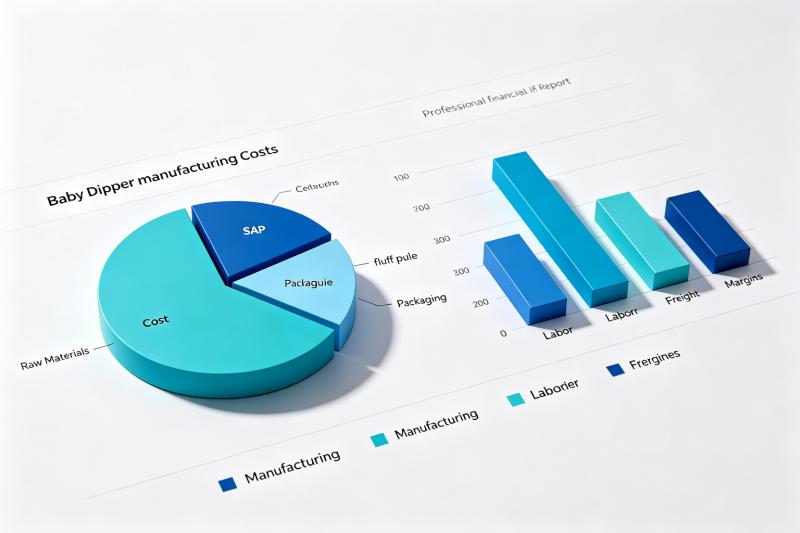
Private label diaper costs break down into five major categories. Understanding the relative weight of each category helps you identify where negotiation and optimization will have the greatest impact:
| Cost Category | % of FOB Cost | Primary Drivers |
|---|---|---|
| Raw materials | 60-70% | SAP, fluff pulp, nonwoven, PE film, elastic, adhesive |
| Manufacturing & labor | 10-15% | Line speed, efficiency, labor rates, overhead |
| Packaging | 5-10% | Polybag/box, printing, pack count, cartons |
| Quality & testing | 2-5% | Incoming inspection, in-process QC, third-party testing |
| Manufacturer margin | 8-12% | Order volume, relationship, complexity |
Raw materials dominate the cost structure at 60-70% of FOB price. This means commodity price fluctuations (especially SAP and pulp) have a direct and significant impact on your unit cost. Smart buyers track raw material indices and negotiate price adjustment clauses in their supply agreements.
2. Raw Material Cost Breakdown
The following table shows the typical raw material cost breakdown for a standard Size 3 baby diaper (480mm length, 12g SAP, fluff+SAP core, standard PE back sheet) at full container volume (2026 price benchmarks):
| Material | Usage per Diaper | Unit Price (USD) | Cost per Diaper (USD) | % of Material Cost |
|---|---|---|---|---|
| Superabsorbent polymer (SAP) | 12 g | $2.20/kg | $0.0264 | 28% |
| Fluff pulp | 18 g | $0.95/kg | $0.0171 | 18% |
| Top sheet nonwoven (PP) | 0.045 m² | $1.80/kg (20 GSM) | $0.0016 | 2% |
| Back sheet PE film | 0.055 m² | $1.50/kg (20 GSM) | $0.0017 | 2% |
| Acquisition layer (ADL) | 0.035 m² | $2.20/kg (30 GSM) | $0.0023 | 2% |
| Leg elastic | 2 strands x 400mm | $0.0008/strand | $0.0016 | 2% |
| Waist elastic | 4 strands x 440mm | $0.0008/strand | $0.0035 | 4% |
| Fastening tapes (2 pcs) | 2 pcs | $0.0040/pc | $0.0080 | 8% |
| Landing zone | 0.015 m² | $2.50/kg | $0.0010 | 1% |
| Tissue wrap (2 layers) | 0.09 m² | $1.20/kg (15 GSM) | $0.0016 | 2% |
| Hot melt adhesive | 1.5 g | $2.80/kg | $0.0042 | 4% |
| Wetness indicator | 1 strip | $0.0030/strip | $0.0030 | 3% |
| Miscellaneous (dust, release paper) | — | — | $0.0020 | 2% |
| Total raw materials | $0.0740 | 100% |
Key observations:
- SAP alone accounts for 28% of material cost. A 10% change in SAP price moves unit cost by approximately $0.0026 (3.5% of total material cost)
- Fluff pulp is the second largest at 18%. Pulp prices are tied to global softwood lumber markets and can be volatile
- Fastening tapes are surprisingly expensive at 8% of material cost. Hook-and-loop (Velcro-style) tapes cost 2-3x more than standard adhesive tapes
- The top sheet and back sheet together are only 4% of material cost — upgrading these materials has a relatively small impact on total cost but a significant impact on perceived quality
- Wetness indicators add 3% to material cost. Many economy brands omit them to save cost, but they are expected in premium and mid-range products
3. Manufacturing and Labor Costs
Manufacturing costs include direct labor, machine depreciation, factory overhead, and utilities. For a modern Chinese diaper factory operating at 80% utilization:
| Cost Component | Cost per Diaper (USD) | Notes |
|---|---|---|
| Direct labor | $0.0040 | Line operators, packers, QC inspectors. ~15 workers per line, 500 ppm speed |
| Machine depreciation | $0.0030 | $2-5M per line, 10-year depreciation, 80% utilization |
| Factory overhead | $0.0025 | Rent, management, maintenance, R&D, admin |
| Utilities (electricity, water, compressed air) | $0.0015 | High-speed lines consume significant electricity for heating and vacuum |
| Total manufacturing | $0.0110 |
Manufacturing efficiency is a key differentiator between factories. A line running at 500 pieces per minute (ppm) with 95% efficiency produces approximately 650,000 diapers per day. A slower line at 300 ppm with 85% efficiency produces only 367,000 diapers per day — nearly half the output with the same labor cost. This is why high-speed, well-maintained lines can offer lower per-unit pricing despite higher capital investment.
4. Packaging Costs
Packaging costs depend on pack format, pack count, and printing complexity. For a standard Size 3 diaper in a 50-count polybag with 4-color flexographic printing:
| Packaging Component | Cost per Diaper (USD) | Notes |
|---|---|---|
| Polybag (PE, 50-count) | $0.0040 | $0.20 per bag / 50 diapers. 60-micron PE, resealable label |
| Printing (4-color flexo) | $0.0010 | Included in bag cost for standard designs. Custom plates: $500-1,500 one-time |
| Carton (5 bags per carton) | $0.0020 | $0.50 per carton / 250 diapers. 5-ply corrugated, export grade |
| Pallet & stretch wrap | $0.0005 | $2.00 per pallet / ~4,000 diapers |
| Total packaging | $0.0075 |
Packaging cost optimization strategies:
- Increase pack count: Larger packs (80-100 count) reduce per-diaper packaging cost by 20-30%, but increase per-unit purchase cost and may not fit all retail channels
- Reduce printing colors: 1-2 color printing costs 30-50% less than 4-color. Many economy brands use 1-2 color printing with a simple logo
- Use cartons without polybags: For institutional and wholesale channels, diapers can be packed directly in cartons without individual polybags, saving $0.005 per diaper
- Standardize carton dimensions: Custom carton sizes increase cost. Standardizing to fit 40ft container dimensions optimizes cube utilization and reduces per-unit freight
5. Complete FOB Cost Model
Combining all cost components, the FOB (Free On Board) cost per Size 3 diaper at full container volume (40,000 diapers per container, 50-count packs):
| Cost Component | Cost per Diaper (USD) | % of FOB |
|---|---|---|
| Raw materials | $0.0740 | 67.3% |
| Manufacturing & labor | $0.0110 | 10.0% |
| Packaging | $0.0075 | 6.8% |
| Quality & testing | $0.0030 | 2.7% |
| Manufacturer margin (10%) | $0.0106 | 9.6% |
| Bank fees & export docs | $0.0010 | 0.9% |
| Inland transport to port | $0.0015 | 1.4% |
| Port handling & THC | $0.0014 | 1.3% |
| FOB price per diaper | $0.1100 | 100% |
| FOB per 40ft container (40,000 pcs) | $4,400 |
This is a benchmark for a standard mid-range Size 3 diaper. Actual FOB prices vary based on:
- Size: NB diapers cost $0.06-0.08 FOB; Size 5-6 cost $0.15-0.22 FOB due to more material and SAP
- Quality tier: Economy diapers cost 20-30% less (less SAP, thinner materials, no wetness indicator); premium diapers cost 30-50% more (more SAP, breathable back sheet, softer nonwoven, hook-and-loop tapes)
- Order volume: MOQ orders (100,000 pcs) cost 15-25% more per unit than full container orders. Annual volume commitments of 5+ containers can reduce pricing by an additional 5-10%
- Customization: Custom dimensions, special features, or unique packaging add 5-15% to FOB cost
6. Landed Cost: From FOB to Your Warehouse
FOB price is only the starting point. Landed cost includes ocean freight, insurance, duties, customs clearance, and inland transport to your warehouse. For a 40ft container from Shanghai to Los Angeles (2026 benchmark rates):
| Cost Component | Cost per Container (USD) | Cost per Diaper (USD) |
|---|---|---|
| FOB value (40,000 pcs) | $4,400 | $0.1100 |
| Ocean freight (40ft HC) | $2,800 | $0.0700 |
| Marine insurance (0.3% of CIF) | $22 | $0.0006 |
| US customs duty (0% for diapers, HS 9619.00) | $0 | $0.0000 |
| Merchandise processing fee (MPF, 0.3464%) | $15 | $0.0004 |
| Harbor maintenance fee (HMF, 0.125%) | $5 | $0.0001 |
| Customs broker fee | $150 | $0.0038 |
| Destination THC & port handling | $350 | $0.0088 |
| Chassis & drayage to warehouse | $450 | $0.0113 |
| Warehouse receiving & putaway | $200 | $0.0050 |
| Total landed cost | $8,392 | $0.2098 |
Key observations:
- Ocean freight nearly doubles the FOB cost in this example. Freight rates are highly volatile — in 2021, 40ft container rates from China to US West Coast exceeded $15,000, adding $0.375 per diaper. In 2023-2024, rates dropped to $1,500-2,500. Always build freight volatility into your pricing model
- Baby diapers (HS code 9619.00.10) enter the US duty-free under normal trade relations. However, Section 301 tariffs on Chinese goods have at various times added 7.5-25% duties. Verify current tariff status before pricing
- EU tariffs on baby diapers from China are 0% (duty-free under standard EU tariff schedule), but VAT (19-27% depending on country) applies at import
- Middle East (GCC) tariffs are typically 5% of CIF value. Southeast Asian tariffs vary 0-10% depending on country and trade agreements
7. Retail Pricing and Margin Model
Using the landed cost of $0.21 per Size 3 diaper, the following table shows typical retail pricing and margin structures across different sales channels:
| Channel | Pack Size | Retail Price (USD) | Price per Diaper | Gross Margin | Margin per Diaper |
|---|---|---|---|---|---|
| Mass retail (Walmart/Target) | 50 ct | $12.99 | $0.26 | 19% | $0.05 |
| Mid-range retail (drugstore) | 50 ct | $16.99 | $0.34 | 38% | $0.13 |
| Premium retail (specialty/boutique) | 50 ct | $24.99 | $0.50 | 58% | $0.29 |
| Amazon FBA (private label) | 50 ct | $19.99 | $0.40 | 48% | $0.19 |
| DTC subscription | 50 ct | $17.99 | $0.36 | 42% | $0.15 |
| Wholesale/distributor | 50 ct | $9.50 | $0.19 | -10% | -$0.02 |
Important notes:
- Mass retail margins are thin (15-20%) but volumes are high. National brands like Pampers and Huggies leverage economies of scale and brand premium to maintain profitability. Private label brands in mass retail typically operate on 10-15% margins
- Amazon FBA fees (referral fee 15% + FBA fulfillment ~$3-5 per pack + storage) reduce the effective margin. The 48% gross margin shown is before Amazon fees; net margin after fees is typically 20-30%
- Wholesale pricing at $9.50 per pack ($0.19 per diaper) is below landed cost in this example — this would be a loss. Wholesale buyers typically negotiate FOB prices 15-25% below the benchmark used here (larger volumes, simpler packaging, economy specifications) to make wholesale economics work
- DTC subscription offers the best margin profile with direct customer relationships and predictable recurring revenue. Customer acquisition cost (CAC) must be factored in — typical CAC for DTC diaper brands is $15-40 per customer
8. Cost Optimization Strategies
8.1 Raw Material Optimization
- SAP loading optimization: Work with your manufacturer to find the minimum SAP loading that meets your absorbency specifications. Reducing SAP from 12g to 10g saves $0.0044 per diaper (4% of FOB) without noticeable performance difference if core design is optimized
- Alternative SAP grades: Standard SAP costs $2.00-2.40/kg. Economy-grade SAP (slower absorption, lower gel strength) costs $1.60-1.90/kg and can reduce SAP cost by 15-20%. Suitable for economy and mid-range products
- Pulp substitution: Blending recycled pulp with virgin pulp can reduce pulp cost by 10-15%, but may affect absorbency rate and softness. Test thoroughly before committing
- Material consolidation: Using a single nonwoven supplier for top sheet, ADL, and landing zone can reduce cost through volume discounts and simplified logistics
8.2 Packaging and Logistics Optimization
- Cube optimization: Work with your manufacturer to design pack and carton dimensions that maximize 40ft container cube utilization. A well-optimized container can hold 10-15% more diapers than a poorly optimized one, reducing per-unit freight by the same percentage
- Compressed packaging: Some manufacturers offer vacuum-compressed packaging that reduces pack volume by 20-30%. This increases container capacity but may affect diaper softness and requires consumer education
- Freight contracting: For annual volumes of 20+ containers, negotiate annual freight contracts with forwarders to lock in rates and avoid spot market volatility. Annual contracts typically save 10-20% vs. spot rates
- Port selection: Shipping from the nearest port to your manufacturer reduces inland transport cost. Shanghai, Ningbo, Shenzhen, and Qingdao are the major diaper export ports. Inland transport from factory to port adds $0.001-0.003 per diaper
8.3 Order and Production Optimization
- Annual volume commitments: Committing to annual volumes of 500,000+ diapers per size can reduce FOB pricing by 5-10% through raw material volume purchasing and production scheduling efficiency
- Reduce SKU complexity: Each additional size or pack configuration requires line changeovers (1-4 hours each) and minimum order quantities. Focusing on 3-4 core sizes with 1-2 pack configurations reduces per-unit cost by 5-8%
- Long-term supplier partnerships: Manufacturers prioritize long-term customers for pricing, production slots, and quality resources. A 3-year supply agreement with annual price review clauses can lock in favorable pricing and provide raw material price protection
- Joint raw material purchasing: For large buyers, some manufacturers offer to purchase raw materials jointly or pass through raw material costs at manufacturer's cost plus a fixed conversion fee. This reduces the manufacturer's margin on materials and can save 3-5% on FOB
9. Hidden Costs and Risks
First-time private label buyers often overlook the following costs, which can significantly impact total landed cost and profitability:
- Tooling and plate fees: Custom cutting tools ($2,000-5,000 per size), printing cylinders ($500-1,500 per color), and mold fees are one-time costs that must be amortized over production volume. For a first order of 100,000 diapers, tooling can add $0.05-0.10 per diaper
- Product testing and certification: Third-party testing (absorbency, skin irritation, microbiological) costs $500-2,000 per product. CE marking technical files, FDA registration, and ISO 13485 audits add $2,000-10,000 in initial costs. Budget $0.01-0.03 per diaper for testing on first orders
- Quality inspection: Third-party pre-shipment inspection (PSI) costs $200-500 per shipment. For quality-critical products, consider during-production inspection (DUPRO) as well, adding another $300-500
- Currency fluctuation: Most Chinese manufacturers quote in USD, but their costs are in RMB. A 5% RMB appreciation can squeeze manufacturer margins and lead to price increases. Some manufacturers offer RMB pricing to share currency risk
- Raw material price escalation: SAP and pulp prices can move 10-30% in a year. Without price adjustment clauses, manufacturers may absorb short-term increases but will eventually request price hikes. Build 3-5% raw material buffer into your pricing model
- Inventory carrying cost: A 40ft container of diapers represents $8,000-12,000 in inventory. At 20% annual carrying cost (warehouse, capital, obsolescence), holding 3 months of inventory adds $0.01-0.02 per diaper. Optimize inventory turns to reduce this cost
- Returns and defects: Budget 1-3% of revenue for returns, defects, and customer complaints. Quality issues can lead to chargebacks, Amazon listing suspensions, and brand damage that far exceed the direct cost of defective products
- Compliance and regulatory changes: New regulations (e.g., EU PPWR packaging requirements, chemical restrictions, carbon border taxes) can require product reformulation or packaging changes, adding cost and complexity. Stay informed about regulatory changes in your target markets
10. How to Use This Model
- Start with your target retail price: Determine the price point you want to sell at in your target channel. This determines your maximum allowable landed cost
- Work backwards to FOB: Subtract freight, duties, and your required margin from retail price to determine your target FOB price per diaper
- Match specifications to target FOB: Adjust SAP loading, materials, features, and pack configuration to hit your target FOB. Use the cost breakdown in this guide to identify which levers have the greatest impact
- Request quotes from 3-5 manufacturers: Provide detailed specifications and request itemized quotes (materials, manufacturing, packaging separately). Compare total cost, not just FOB price — a slightly higher FOB from a higher-quality manufacturer may reduce defect rates and returns
- Validate with samples and small test orders: Before committing to full containers, order pre-production samples and a small trial order (10,000-20,000 pcs). Test absorbency, fit, packaging quality, and customer feedback. Adjust specifications based on results
- Build a 12-month rolling forecast: Diaper costs change with raw material prices, freight rates, and exchange rates. Update your cost model monthly and adjust retail pricing or negotiate with suppliers when costs move significantly
- Negotiate price adjustment clauses: Include clauses in your supply agreement that tie FOB pricing to raw material indices (e.g., SAP price index, pulp price index). This provides transparency and protects both parties from extreme price movements
Looking for an OEM Partner?
New Yifa Group is a leading hygiene product manufacturer in China since 1994, with 68 production lines and exports to 88+ countries. We offer transparent, itemized pricing for private label baby diapers with low MOQ, custom packaging, and ISO 13485/CE/FDA certification. Contact us for a detailed cost breakdown based on your specific specifications and target market.
Explore our OEM/ODM customization capabilities | Request a detailed cost quote