
Disposable underpad OEM specification guide for B2B buyers: hospital-grade sizes, absorbency under pressure, core construction, raw materials, manufacturing, QC testing, certifications and cost.
Underpads OEM: Hospital-Grade Specification Guide for B2B Buyers
For a complete overview of adult incontinence types, products and OEM options, read our Adult Incontinence Guide.
Disposable underpads (also called bed pads, chux pads, or hospital pads) are a high-volume, high-margin category in adult incontinence care. Used in hospitals, nursing homes, home care, and veterinary settings, underpads require precise specification control to meet medical-grade performance standards. This guide covers everything OEM buyers, distributors, and healthcare procurement teams need to know when sourcing private label underpads from Chinese manufacturers.
1. Underpad Market Overview
The global disposable underpad market is driven by three demand engines:
- Healthcare institutional: Hospitals, clinics, and surgery centers use underpads for patient bed protection, procedure pads, and post-surgical care. This segment demands consistent quality, sterilization options, and bulk pricing
- Long-term care: Nursing homes, assisted living, and hospice care are the largest volume segment. Residents with moderate to severe incontinence require high-absorbency underpads changed multiple times daily
- Home care: Aging-in-place trends drive growth in retail and DME (durable medical equipment) channels. Home users prefer consumer-friendly packaging, brand choices, and subscription models
- Veterinary: Pet training pads and veterinary clinic pads use similar manufacturing technology, often with lighter specifications and lower price points
Key market trends include super-absorbent polymer (SAP) upgrades for thinner, higher-capacity pads; breathable back sheets for skin integrity; biodegradable material options; and private label growth as healthcare systems seek cost savings without sacrificing quality.
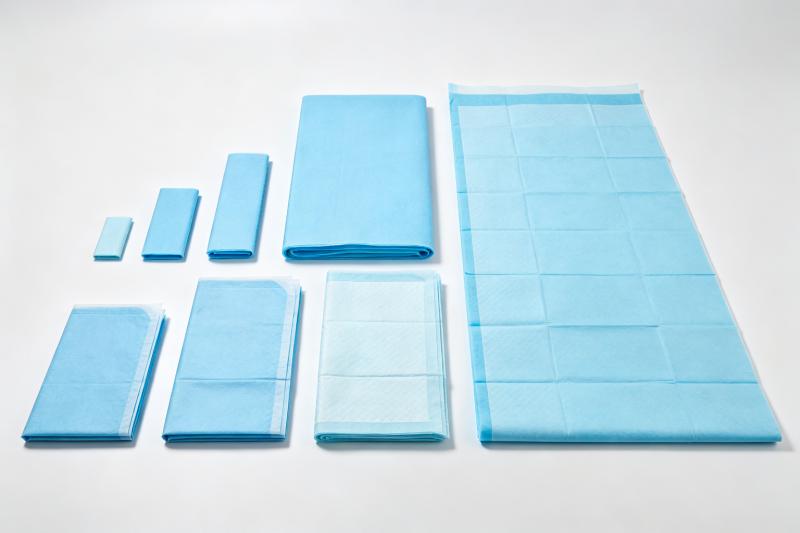
2. Product Specifications
2.1 Standard Sizes and Absorbency
| Size Designation | Dimensions (cm) | Typical Absorbency | Common Use |
|---|---|---|---|
| Small / Pediatric | 40 x 60 | 500-800ml | Pediatric, veterinary, procedure pads |
| Regular / Standard | 60 x 60 | 800-1200ml | Standard hospital bed, general use |
| Large | 60 x 90 | 1200-1800ml | Hospital/twin bed, heavy use |
| Extra Large / Bariatric | 90 x 180 | 2000-3000ml | Bariatric beds, full bed coverage |
| XXL / Queen/King | 150 x 200+ | 3000-5000ml | Full bed coverage, couples, home care |
Note: Absorbency ratings are typically measured under free-swell (no pressure) conditions. For healthcare applications, "absorbency under pressure" (e.g., 0.5 psi or 1.0 psi) is a more meaningful specification, as it reflects real-world performance when a patient is lying on the pad.
2.2 Construction Types
- Fluff pulp core (standard): Traditional construction using cellulose fluff pulp as the primary absorbent. Lower cost, thicker profile (3-8mm), suitable for light to moderate use. Most common in economy and institutional segments
- Fluff + SAP core (moderate): Blend of fluff pulp and superabsorbent polymer (SAP) granules. SAP content typically 2-8g per pad. Thinner profile (2-5mm), higher absorbency, reduced rewet. Standard for mid-range and premium hospital use
- Airlaid + SAP core (premium): Airlaid paper core with high SAP loading (5-15g per pad). Thinnest profile (1.5-3mm), highest absorbency-to-thickness ratio, excellent dry feel. Used in premium retail and high-acuity care
- Dual-core / layered: Two-layer core design with acquisition layer on top and SAP-rich storage layer below. Optimizes liquid distribution and prevents pooling. Used in heavy-use and bariatric formats
2.3 Hospital-Grade Performance Standards
Hospital-grade underpads must meet specific performance criteria beyond basic absorbency:
- Absorbency under pressure (AUP): Measured at 0.5 psi (3.4 kPa) for 30 minutes. Hospital-grade pads typically retain 60-80% of free-swell capacity under pressure
- Rewet value: Amount of liquid released back when pressure is applied after absorption. Hospital-grade target: < 5g for moderate-use pads, < 10g for heavy-use. Low rewet protects skin integrity and reduces hospital-acquired pressure injuries
- Runoff / strike-through: Liquid must absorb quickly (acquisition time < 10 seconds for first insult) without running off the pad edges. Critical for patient safety and bed linen protection
- Wet strength: Pad must maintain structural integrity when saturated. Tensile strength when wet: minimum 15N (machine direction) for standard pads, 25N for heavy-use and bariatric
- Back sheet integrity: No leakage through back sheet under 50cm water pressure for 24 hours. Critical for bed linen and mattress protection
- Lint and dust: Low-linting construction to maintain cleanroom and surgical environment standards. Airlaid cores produce less lint than loose fluff pulp
- Odor control: Optional odor-neutralizing technologies (zeolite, activated carbon, citrus extracts) for long-term care and home use
3. Raw Materials
3.1 Top Sheet (Acquisition Layer)
- Polypropylene (PP) spunbond nonwoven: Most common, 15-25 GSM. Hydrophilic treatment for quick liquid acquisition. Soft, low-linting, cost-effective
- Perforated PE film: Provides dry feel and quick acquisition, used in economy formats. Less soft than nonwoven
- Bi-component (PE/PP) nonwoven: Premium soft feel, used in retail and premium segments
- Color options: Standard blue (hospital), pink, green, white, or custom colors for brand differentiation. Blue is preferred in healthcare as it provides visual contrast for fluid detection
3.2 Absorbent Core
- Cellulose fluff pulp: Primary absorbent material in standard pads. Sourced from softwood (long fiber) for strength and absorbency. Typical basis weight: 100-400 GSM depending on size and absorbency rating
- Superabsorbent polymer (SAP): Sodium polyacrylate granules, 2-15g per pad depending on specification. Provides gel-lock technology, high absorbency-to-weight ratio, and low rewet. Hospital-grade SAP must meet biocompatibility standards (ISO 10993)
- Airlaid paper: Composite of cellulose fibers and binder, used in premium thin pads. 80-200 GSM, provides core integrity and reduced linting
- Tissue paper: Wraps the core for integrity, 12-18 GSM. Prevents SAP migration and maintains core structure
3.3 Back Sheet (Barrier Layer)
- PE film: Standard liquid-proof barrier, 15-30 GSM. Available in various colors. Must be pinhole-free and meet hydrostatic pressure resistance standards
- Breathable PE film: Microporous film allows air and moisture vapor transmission while preventing liquid penetration. Reduces skin maceration and improves patient comfort. Higher cost, used in premium and long-term care segments
- Nonwoven/PE laminate: Cloth-like back sheet with soft feel, used in retail premium segments
- Biodegradable film: PLA or bio-PE for eco-friendly positioning. Higher cost, may require industrial composting conditions
3.4 Adhesive and Additional Features
- Positioning adhesive: Pressure-sensitive adhesive strips on the back sheet to secure the pad to bed linens. Prevents shifting and bunching. Must be skin-safe and residue-free when removed from linens
- Wetness indicator: Optional color-changing ink that fades when wet, helping caregivers know when to change the pad. Used in premium and long-term care segments
- Handles / straps: Optional integrated handles for easy removal and disposal, used in bariatric and heavy-use formats
- Antimicrobial treatment: Optional silver ion or zinc pyrithione treatment for odor control and infection prevention, used in high-acuity and surgical settings
4. Manufacturing Process
4.1 Converting Line Process
Underpad production uses a high-speed converting line (typically 300-800 pieces per minute) that transforms raw materials into finished, packaged underpads:
- Unwinding: Raw material rolls (top sheet, back sheet, tissue, fluff pulp) are loaded and unwound at controlled tension
- Core formation: Fluff pulp is defibrated and formed into a continuous web of specified basis weight. SAP is applied uniformly via a dosing system (for fluff+SAP construction). For airlaid cores, pre-made airlaid sheets are unwound and SAP is applied between layers
- Core wrapping: The absorbent core is wrapped in tissue paper and compressed to target thickness
- Lamination: Top sheet and back sheet are laminated around the core using hot melt adhesive (spray or slot-die application). Adhesive coverage patterns are optimized for bond strength without compromising absorbency
- Feature application: Positioning adhesive strips, wetness indicators, or other features are applied at this stage
- Cutting: The continuous web is cut to individual pad dimensions using rotary knives or guillotine cutters
- Counting and stacking: Pads are counted and stacked into the desired pack count (typically 10, 25, 50, or 100 per pack)
- Packaging: Stacks are inserted into outer packaging (polybag, cardboard box, or retail-ready packaging) and sealed
- Cartoning and palletizing: Finished packs are cartoned and palletized for shipping
4.2 Sterilization Options
For surgical and high-acuity applications, underpads may require sterilization:
- ETO (Ethylene Oxide) sterilization: Most common for medical-grade underpads. Penetrates packaging, effective against all microorganisms including spores. Requires aeration period to remove residual ETO. Typical cycle: 12-24 hours including aeration
- Gamma irradiation: Penetrates packaging, no aeration needed. Higher cost, may cause material degradation (yellowing, reduced tensile strength) over time. Used for implants and critical devices, less common for underpads
- Cleanroom production (non-sterile): For non-sterile hospital use, production in a Class 100,000 cleanroom with bioburden control is often sufficient. Products meet AAMI/ISO 11137 bioburden limits without full sterilization
5. Quality Control and Testing
5.1 Incoming Material Inspection
- Fluff pulp: moisture content (< 8%), fiber length distribution, absorbency rate, visual inspection for contaminants
- SAP: absorbency capacity (g/g), absorption rate, particle size distribution, moisture content, residual monomer (< 1000 ppm for medical grade)
- Nonwoven: basis weight (±5%), tensile strength, hydrostatic head, visual inspection for defects
- PE film: thickness (±10%), pinhole test, tensile strength, seal strength
- Adhesive: viscosity, peel strength, skin-safety certification (ISO 10993-10)
5.2 In-Process Quality Control
- Core weight verification (gravimetric, every 30 minutes)
- SAP dosing accuracy (±5% of target)
- Adhesive application weight and pattern verification
- Cut dimension accuracy (±2mm)
- Continuous vision system inspection for defects (holes, misalignment, missing core, foreign objects)
- Pack count verification (automatic counters with manual spot checks)
5.3 Finished Product Testing
- Free-swell absorbency: Per EDANA/INDA standard WSP 240.0.R2 (0.9% saline solution, 30 minutes)
- Absorbency under pressure (AUP): Per WSP 240.0.R2 at 0.5 psi for 30 minutes
- Rewet value: Per internal or customer-specific method (standard weight on saturated pad, measure liquid transferred to filter paper)
- Acquisition time: Time for first and subsequent insults to fully absorb (target < 10 seconds first insult, < 20 seconds third insult)
- Wet tensile strength: Per WSP 110.4.R0, machine and cross direction
- Back sheet hydrostatic resistance: Per WSP 80.6.R0, minimum 50cm water column for 24 hours
- Microbiological testing: Per USP 61/62 or EP 2.6.12/2.6.13. Bioburden limits for non-sterile medical devices per ISO 11737-1
- Sterility verification: For sterile products, per ISO 11135 (ETO) or ISO 11137 (irradiation), with sterility audit per USP 71
- Packaging integrity: Seal strength, burst test, drop test, simulated transport vibration
6. Certifications and Compliance
| Certification | Requirement | Applicable Segment |
|---|---|---|
| ISO 9001 | Quality management system | All |
| ISO 13485 | Medical device quality management | Medical-grade, sterile |
| ISO 14001 | Environmental management | Eco-friendly positioning |
| CE Marking (MDR) | EU Medical Device Regulation (Class I) | European Union, medical use |
| FDA 510(k) / Registration | US FDA facility registration and product listing | United States, medical use |
| Health Canada MDEL | Medical Device Establishment License | Canada |
| TGA Registration | Therapeutic Goods Administration | Australia |
| ISO 10993 | Biological evaluation of medical devices (cytotoxicity, sensitization, irritation) | Medical-grade, skin-contact |
| ISO 11135 / 11137 | Sterilization validation (ETO / irradiation) | Sterile products |
| OEKO-TEX 100 | Textile free from harmful substances | Premium, skin-sensitive |
| Halal Certified | Ingredients and process comply with Islamic law | Middle East, Southeast Asia |
7. OEM/ODM Customization Options
7.1 Private Label (OEM)
- Custom branding on packaging (logo, design, copy)
- Choice from manufacturer's existing specification library (standard sizes and absorbency ratings)
- Custom pack sizes and counts
- Typical MOQ: 50,000 pads per SKU (approximately 1,000 packs of 50)
- Lead time: 30-45 days after artwork approval
7.2 Custom Development (ODM)
- Custom product specifications (dimensions, absorbency, core construction)
- Custom material selection (breathable back sheet, airlaid core, premium nonwoven)
- Custom features (wetness indicator, positioning adhesive, antimicrobial treatment, handles)
- Custom packaging formats (retail-ready, sterile pouch, dispenser box)
- Typical MOQ: 50,000 pads per SKU
- Development time: 4-8 weeks (including performance testing and validation)
- Lead time: 45-60 days after approval
7.3 Packaging Customization
- Polybag with resealable label (standard institutional)
- Cardboard box (retail, sterile, premium)
- Retail-ready packaging (RRP) for shelf display
- Individual sterile pouch (surgical, procedure pads)
- Dispenser box (wall-mount or tabletop for institutional use)
- Printing: up to 8-color flexographic or rotogravure
- Pack counts: 10 (travel/procedure), 25, 50 (standard), 100 (value/institutional)
8. Cost Structure and Pricing
Underpad manufacturing costs are driven by:
- Core material: Fluff pulp is the largest cost component (30-40% of material cost). SAP adds 10-25% depending on loading. Airlaid cores cost 20-40% more than fluff pulp
- Size and absorbency: Larger sizes and higher absorbency ratings require more material, increasing cost proportionally
- Back sheet type: Breathable PE film costs 15-25% more than standard PE film
- Special features: Wetness indicators, positioning adhesive, and antimicrobial treatments add 5-15% to unit cost
- Sterilization: ETO sterilization adds 20-35% to unit cost, including validation and aeration
- Order volume: Full container pricing vs. MOQ pricing can differ by 15-25%
- Certification requirements: Medical-grade (ISO 13485, CE MDR, FDA) requires additional quality systems and testing, adding 10-20% overhead
As a rough benchmark, standard 60x90cm fluff+SAP underpads (5g SAP, standard PE back sheet, 50-count polybag) in full container volumes typically range from $0.08 to $0.15 FOB per pad. Premium hospital-grade 60x90cm airlaid+SAP pads (10g SAP, breathable back sheet, positioning adhesive, 25-count retail box) range from $0.18 to $0.30 per pad. Sterile versions add 20-35%.
9. How to Select an Underpad Manufacturer
- Dedicated underpad lines: Verify the manufacturer has dedicated underpad converting lines (not just shared adult diaper lines). New Yifa Group operates multiple high-speed underpad lines with annual capacity exceeding 500 million pads
- Cleanroom production: Medical-grade underpads must be manufactured in a controlled cleanroom environment (Class 100,000 or better) with bioburden control. Verify cleanroom certification and monitoring protocols
- SAP handling and dosing: SAP is the most critical material for performance. Verify the manufacturer has precise SAP dosing systems (±5% accuracy) and can handle different SAP grades (standard, fast-absorbing, low-odor)
- In-house lab capabilities: A manufacturer with an in-house QC lab can perform absorbency testing, rewet testing, tensile testing, and microbiological testing without relying on third-party labs, reducing lead times and improving quality control
- Medical device certification: For medical-grade products, verify ISO 13485 certification, CE MDR compliance (Class I), and FDA registration. Verify the manufacturer has a Quality Management System (QMS) specific to medical devices
- Sterilization capabilities: If sterile products are needed, verify the manufacturer has ETO sterilization capabilities (in-house or reliable third-party) and can provide sterilization validation documentation per ISO 11135
- Quality track record: Request references from existing healthcare clients. Ask about rejection rates, on-time delivery performance, and responsiveness to quality issues. Request recent audit reports (customer audits or third-party audits)
- Regulatory support: A good manufacturer provides regulatory support documentation, including technical files, Declaration of Conformity, test reports, and material safety data sheets (MSDS). This is critical for medical device registration in target markets
10. Common Pitfalls to Avoid
- Specifying only free-swell absorbency: Free-swell numbers look impressive but don't reflect real-world performance. Always specify absorbency under pressure (AUP) and rewet value, which are more meaningful for patient care
- Ignoring back sheet breathability: Non-breathable back sheets can contribute to skin maceration and pressure injuries in long-term care. Specify breathable back sheets for premium and long-term care segments
- Overlooking wet strength: Pads that tear when saturated create mess and infection risk. Specify minimum wet tensile strength and verify with testing
- Skipping pre-production samples: Always request and approve pre-production samples (PPS) before mass production. Verify absorbency, rewet, softness, dimensions, and packaging quality against your specifications
- Not validating sterilization: For sterile products, require sterilization validation reports (ISO 11135) and sterility audit results. Never accept "sterile" claims without documentation
- Underestimating regulatory requirements: Medical-grade underpads are classified as Class I medical devices in most markets. Verify registration requirements, technical file documentation, and labeling regulations for each target market before production
Looking for an OEM Partner?
New Yifa Group is a leading hygiene product manufacturer in China since 1994, with 68 production lines and exports to 88+ countries. We offer OEM/ODM services for disposable underpads, adult diapers, and incontinence products with low MOQ, custom packaging, and ISO 13485/CE/FDA certification.
Explore our adult incontinence OEM capabilities | Request a free quote