
Detailed guide to materials and comfort features in OEM adult pull up diapers. Covers SAP selection, fluff pulp, non-woven top sheet, breathable backsheet, leg cuffs, elastic waistband, odour control, skin health and material testing.
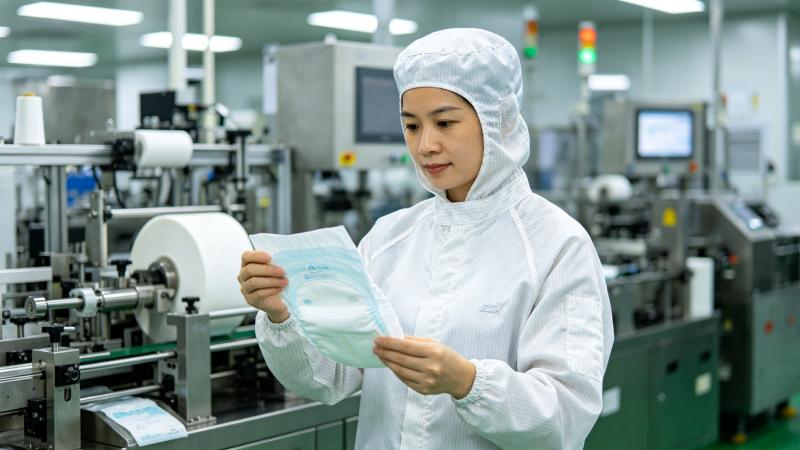
The materials used in an adult pull up diaper determine not only its absorbent performance but also its comfort, skin compatibility, and perceived quality. Adult incontinence product users wear diapers for extended periods — often 4-8 hours during the day and 8-12 hours overnight — with the materials in direct contact with sensitive skin. Poor material quality can cause skin irritation, allergic reactions, discomfort, and odour, leading to product dissatisfaction and brand switching. For OEM buyers, specifying the right materials — and verifying that the manufacturer actually uses them — is the most important factor in product quality and user satisfaction. This guide provides a detailed overview of each material component, the key quality parameters to specify, and how to evaluate and verify material quality with China manufacturers.
This article is part of our cluster on OEM adult pull up diapers manufacturer.
Superabsorbent Polymer (SAP): The Most Critical Material
Superabsorbent polymer (SAP, sodium polyacrylate) is the most expensive and most performance-critical raw material in an adult pull up diaper. It is responsible for absorbing and retaining liquid, converting it to a gel that cannot leak back out. SAP typically accounts for 30-40% of the total raw material cost of an adult pull up diaper, making it the primary target for cost reduction — and the primary source of quality problems when inferior SAP is used.
Key SAP Quality Parameters
- Absorption capacity (centrifuge retention capacity, CRC): The amount of liquid the SAP can absorb and retain after centrifuging (removing free liquid). Measured in g/g for 0.9% saline. High-quality SAP has CRC of 28-35 g/g. Low-quality or recycled SAP may have CRC below 25 g/g.
- Absorption under pressure (AUP): The amount of liquid the SAP can absorb under applied pressure (typically 0.3 psi or 0.7 psi). This is the most important parameter for real-world performance, because in use the SAP is always under body pressure. High-quality SAP has AUP of 22-28 g/g at 0.3 psi and 18-24 g/g at 0.7 psi. Low-quality SAP may have AUP below 18 g/g at 0.3 psi, leading to leakage and high rewet.
- Absorption rate (free swell rate): How quickly the SAP absorbs liquid, measured in seconds for 1g of SAP to absorb a specified volume. Fast absorption rate prevents liquid from pooling on the surface. High-quality SAP has free swell rate of 30-60 seconds for 50ml. Very fast absorption (below 20 seconds) can actually be problematic if the SAP absorbs liquid too quickly and gels before the liquid can distribute through the core, causing gel blocking.
- Gel strength: The mechanical strength of the swollen SAP gel, measured by shear modulus or permeability. High gel strength means the swollen gel maintains its structure under pressure, allowing liquid to penetrate and distribute through the core rather than being blocked by a surface gel layer. Low gel strength SAP becomes soft and mushy when swollen, causing gel blocking, high rewet, and core deformation.
- Particle size distribution: SAP particle size affects absorption rate, core uniformity, and dust generation. Typical particle size range is 150-850 microns, with a mean of 300-400 microns. Too many fine particles (below 150 microns) cause dust during production and may migrate through the core wrap. Too many large particles (above 850 microns) reduce absorption rate and create a gritty feel.
- Residual monomer content: Unreacted acrylic acid monomer in the SAP can cause skin irritation and has an unpleasant odor. High-quality SAP has residual monomer below 500 ppm (typically 200-400 ppm). Low-quality SAP may have residual monomer above 1000 ppm, causing odor and potential skin irritation.
- Moisture content: SAP moisture content affects handling, flowability, and absorption performance. Typical moisture content is 3-8%. Too high moisture (above 10%) causes caking and poor flow during production; too low moisture (below 2%) increases dust generation and static electricity.
Major SAP Suppliers
The global SAP market is dominated by a few major suppliers, each with different product grades and performance characteristics. The most widely used suppliers for hygiene products include:
- BASF (Germany): Luquasorb brand, known for high AUP and gel strength. Widely used in premium adult and baby diapers.
- Evonik (Germany): FAVOR brand, known for high absorption rate and good overall performance. Widely used in both premium and standard products.
- Sumitomo Seika (Japan): Aqualic brand, known for high gel strength and low residual monomer. Popular in Asian markets and premium products.
- Nippon Shokubai (Japan): Aqualic brand (joint venture with Sumitomo), known for high performance and quality consistency.
- Formosa Plastics (Taiwan): Known for good performance at competitive prices. Widely used in mid-range products.
- Luxi Chemical (China): Leading Chinese SAP supplier, with improving quality. Used in value and mid-range products.
- Other Chinese suppliers: Several Chinese SAP manufacturers offer lower-cost SAP, but quality consistency and performance can vary significantly between batches.
When specifying SAP for your product, you can either specify a particular brand and grade (e.g., "BASF Luquasorb 1160") or specify performance parameters (CRC, AUP, absorption rate, residual monomer) and allow the manufacturer to source SAP that meets those specifications. Specifying performance parameters gives the manufacturer more flexibility and may reduce cost, but requires rigorous incoming inspection to verify that the SAP actually meets the specifications. For premium products or first-time orders, specifying a particular brand and grade is recommended to ensure consistent quality.
Fluff Pulp: The Structural Matrix
Fluff pulp (cellulose fiber) provides the structural matrix of the absorbent core, distributing liquid throughout the core and holding the SAP in place. While SAP provides the majority of the absorption capacity, fluff pulp contributes to absorption speed, liquid distribution, and core integrity. Fluff pulp typically accounts for 15-20% of the total raw material cost.
Key Fluff Pulp Quality Parameters
- Fiber length: Longer fibers provide better core integrity and liquid distribution. High-quality fluff pulp has average fiber length of 2.5-3.5mm (softwood pulp). Short-fiber hardwood pulp (1mm average) is not suitable for diaper cores because it produces weak, dusty cores with poor liquid distribution.
- Absorption capacity: Fluff pulp can absorb approximately 8-12 g/g of deionized water and 5-8 g/g of 0.9% saline. While this is much lower than SAP, fluff pulp provides initial rapid absorption and liquid distribution before the SAP can absorb.
- Absorption rate: Fluff pulp absorbs liquid very quickly (within seconds) due to capillary action in the fiber matrix. This rapid initial absorption helps prevent liquid from pooling on the surface while the SAP absorbs more slowly.
- Impurity content: High-quality fluff pulp has low impurity content (below 0.5%), including bark, dirt, and other foreign matter. Impurities can cause skin irritation, affect absorption, and create hard spots in the core. Low-quality pulp may have impurity content above 2%, visible as dark specks in the core.
- Dust content: Excessive dust (fine fiber particles) can cause respiratory issues during production, affect core uniformity, and migrate through the core wrap. High-quality fluff pulp has low dust content (below 5 mg/g).
- Moisture content: Typical moisture content is 6-10%. Too high moisture causes mold growth and reduces absorption; too low moisture increases dust and static.
Major Fluff Pulp Suppliers
The highest-quality fluff pulp comes from Nordic (Swedish, Finnish) and Canadian softwood forests, where long-fiber softwood species (spruce, pine, fir) produce pulp with excellent fiber length and purity. Major suppliers include:
- Stora Enso (Finland/Sweden): Fluff pulp brand, known for high purity and consistent quality.
- UPM (Finland): Fluff pulp brand, known for high fiber length and low impurity.
- Domtar (Canada): Fluff pulp brand, known for good performance at competitive prices.
- Resolute Forest Products (Canada): Fluff pulp supplier for North American market.
- Chinese suppliers: Several Chinese pulp mills produce fluff pulp from domestic or imported softwood, with varying quality. Chinese fluff pulp is generally lower cost but may have higher impurity content and less consistent quality.
For premium adult pull up diapers, specify Nordic or Canadian softwood fluff pulp. For value products, Chinese fluff pulp may be acceptable if the manufacturer has rigorous incoming inspection for impurity content and fiber length.
Non-Woven Fabrics: Comfort and Skin Contact
Non-woven fabrics are used in multiple components of an adult pull up diaper: the top sheet (in contact with the user's skin), the leg cuffs, the waistband outer layer, the core wrap, and the backsheet outer layer (for breathable composite backsheets). The quality of non-woven fabrics directly affects softness, comfort, and skin friendliness.
Top Sheet Non-Woven
The top sheet is the most important non-woven component because it is in direct contact with the user's skin for extended periods. It must be soft, hydrophilic (allow liquid to pass through quickly), non-irritating, and strong enough to withstand friction during wear and removal.
Non-woven types for top sheet:
- Spunbond (SS/SMS): The most common and lowest-cost top sheet material. Spunbond non-woven is made by extruding continuous filaments and bonding them with heat (calender bonding). SS (spunbond-spunbond) and SMS (spunbond-meltblown-spunbond) offer increasing softness and strength. Standard spunbond top sheet has basis weight of 15-20 gsm.
- Through-air bonded (hot-air through-bonded): A premium top sheet material made by bonding fibers with hot air (rather than calender pressure), resulting in a softer, more voluminous, cloth-like texture. Through-air bonded non-woven has basis weight of 18-25 gsm and is significantly softer than spunbond. It is the standard top sheet material for premium adult and baby diapers.
- Hydrophilic treatment: All top sheet non-woven must be treated with a hydrophilic surfactant to allow liquid to pass through quickly. Without hydrophilic treatment, liquid would bead on the surface and not absorb into the core. The hydrophilic treatment must be durable (not wash off after multiple insults) and skin-safe.
Top sheet quality parameters:
- Softness: Measured by hand feel evaluation or instrumental softness testers. Through-air bonded non-woven is significantly softer than spunbond.
- Liquid strike-through time: The time for a fixed volume of liquid to pass through the top sheet. Measured in seconds using a strike-through tester. A good top sheet has strike-through time below 5 seconds for the first insult and below 8 seconds for subsequent insults.
- Rewet (top sheet): The amount of liquid that returns to the top sheet surface after absorption. While rewet is primarily determined by the core, the top sheet can contribute to rewet if it absorbs and holds liquid. A hydrophilic but non-absorbent top sheet (liquid passes through but is not retained) minimizes rewet.
- Tensile strength: The top sheet must be strong enough to withstand friction during wear and removal without tearing or pilling. Minimum tensile strength is typically 10N/5cm in machine direction and 5N/5cm in cross direction.
- Lint and dust: Low-quality non-woven may shed fibers or dust during production and use, causing skin irritation and contamination. High-quality non-woven has low lint content (below 1mg/100cm²).
Leg Cuff Non-Woven
Leg cuffs are elasticated barriers at the leg openings that prevent side leakage. They are typically made of hydrophobic (water-repellent) non-woven to prevent liquid from wicking through the cuff material. Leg cuff non-woven should be soft and flexible to avoid skin irritation and marks, while providing an effective barrier. Basis weight is typically 15-20 gsm. Premium products use softer, higher-basis-weight leg cuff non-woven (20-25 gsm) for improved comfort.
Waistband Non-Woven
The waistband outer layer is typically made of soft, stretchable non-woven that provides a comfortable, cloth-like feel against the skin. Some products use elastic non-woven (containing elastic filaments) for the waistband, while others use standard non-woven with separate elastic strands sandwiched between layers. Waistband non-woven basis weight is typically 18-25 gsm. Premium products use through-air bonded or elastic non-woven for the waistband to improve softness and stretch comfort.
Core Wrap
The core wrap is a thin tissue or non-woven layer that encloses the absorbent core (SAP and fluff pulp), containing the SAP particles and preventing them from migrating out of the core. Core wrap is typically made of wet-laid tissue (12-16 gsm) or spunbond non-woven (10-15 gsm). The core wrap must be strong enough to contain the core during production and use, porous enough to allow liquid to pass through, and have a fine enough mesh to prevent SAP particles from leaking out. Low-quality core wrap can break or tear, causing SAP leakage (gel particles coming through the top sheet or backsheet), which is a serious product defect.
Back Sheet: Waterproofing and Breathability
The back sheet is the outer waterproof layer that prevents liquid from leaking through the diaper and onto the user's clothing or bedding. It must be 100% liquid-proof while remaining comfortable and, ideally, breathable.
Standard PE Film Back Sheet
The most common and lowest-cost back sheet material is polyethylene (PE) film, typically 15-25 microns thick. PE film is 100% waterproof, low-cost, and available in a range of colors and finishes (matte, glossy, embossed). However, PE film is not breathable: it traps heat and moisture vapor against the user's skin, creating a warm, humid environment that can contribute to diaper rash and skin irritation, particularly during extended wear (overnight) or in hot climates. PE film back sheets may also make a crinkling noise when the user moves, which can be a concern for discreetness.
Breathable Composite Back Sheet
Breathable back sheets allow air and moisture vapor to pass through while remaining liquid-proof, reducing the risk of skin irritation and improving comfort. There are two main types of breathable back sheets:
- Micro-porous PE film: PE film filled with calcium carbonate particles and stretched to create micro-pores (0.5-5 microns) that allow moisture vapor to pass through but are too small for liquid water droplets to pass. Micro-porous film has water vapor transmission rate (WVTR) of 500-2000 g/m²/24h. It is more expensive than standard PE film but less expensive than non-woven composite.
- PE film + non-woven composite: A micro-porous PE film laminated to a soft non-woven outer layer (typically 15-20 gsm spunbond). The non-woven layer provides a soft, cloth-like feel, reduces crinkling noise, and improves the premium appearance of the diaper. The composite has WVTR of 800-2500 g/m²/24h. This is the standard back sheet for premium adult and baby diapers.
For adult pull up diapers, where extended wear and skin health are particularly important, breathable back sheets are strongly recommended, especially for heavy and maximum/overnight absorbency products. The additional cost of a breathable back sheet is typically $0.01-$0.03 per piece, which is a worthwhile investment for product quality and user satisfaction.
Back Sheet Quality Parameters
- Hydrostatic pressure (waterproofness): The minimum water pressure (in cmH₂O or mbar) that the back sheet can withstand without leaking. Standard PE film has hydrostatic pressure above 200 cmH₂O; breathable film should have hydrostatic pressure above 100 cmH₂O to ensure adequate waterproofing.
- Water vapor transmission rate (WVTR): For breathable back sheets, WVTR measures how much moisture vapor can pass through in 24 hours (g/m²/24h). Higher WVTR indicates better breathability. Premium breathable composites have WVTR above 1500 g/m²/24h.
- Tensile strength and elongation: The back sheet must be strong enough to withstand production and use without tearing. Minimum tensile strength is typically 10N/25mm in machine direction and 8N/25mm in cross direction, with elongation above 200%.
- Pinhole and defect inspection: Back sheet film should be free of pinholes, thin spots, and other defects that could cause leakage. Manufacturers should conduct online pinhole detection during film production or lamination.
Elastics: Waistband and Leg Cuffs
Elastics are critical for fit and leakage protection. The waistband elastic provides a snug, comfortable fit around the waist; the leg cuff elastic creates a barrier at the leg openings. Poor elastic quality or incorrect elastic tension can cause sagging, leakage, discomfort, and skin marks.
Elastic Strand Types
- Natural rubber (latex) elastic: Traditional elastic material with excellent stretch and recovery properties. However, natural rubber contains latex proteins that can cause allergic reactions in sensitive users. For adult products, where users may have sensitive skin or latex allergies, latex-free elastic is recommended.
- Synthetic elastic (spandex/Lycra, TPU): Latex-free synthetic elastic made from polyurethane (spandex/Lycra) or thermoplastic polyurethane (TPU). Synthetic elastic has good stretch and recovery, is latex-free, and is less likely to cause allergic reactions. Spandex is the most common elastic material for premium adult and baby diapers. TPU elastic film is used in some products for a flat, non-bulky elastic application.
Elastic Quality Parameters
- Stretch ratio: The ratio of stretched length to relaxed length. Waistband elastic should stretch to 2.5-3 times its relaxed length; leg cuff elastic should stretch to 2-2.5 times. Excessive stretch ratio causes the elastic to lose tension over time; insufficient stretch ratio causes a tight, uncomfortable fit.
- Tension (modulus): The force required to stretch the elastic to a specified length. Waistband tension should be 5-15N per strand at the target waist measurement (for a comfortable but secure fit). Leg cuff tension should be 2-8N per strand (for a gentle but effective seal). Excessive tension causes skin marks and discomfort; insufficient tension causes gaps and leakage.
- Elastic recovery (set): The ability of the elastic to return to its original length after stretching. High-quality elastic has recovery above 90% (less than 10% permanent set after 50% stretch for 24 hours). Poor elastic recovery causes the waistband to become loose and sag after wear.
- Durability (fatigue resistance): The elastic should maintain its tension and recovery after repeated stretch cycles (simulating putting on and taking off the diaper, and movement during wear). High-quality elastic maintains above 80% of its original tension after 100 stretch cycles.
Elastic Strand Count and Configuration
The number and placement of elastic strands affect fit and comfort. Waistband typically uses 5-15 elastic strands, distributed across the width of the waistband. More strands provide more uniform tension and a more comfortable fit, but increase cost. Leg cuffs typically use 2-4 elastic strands per cuff. Premium products may use a wider elastic strand configuration (more strands, wider spacing) for a softer, more comfortable fit, while value products may use fewer strands with higher tension per strand.
Additional Comfort and Feature Materials
Odour Control
Odour control is an important feature for adult incontinence products, as urine odor can be a source of embarrassment and discomfort for users. Several odour control technologies are available:
- Perfume/fragrance: Adding a subtle fragrance to the top sheet or core to mask odour. Fragrance can be effective but may cause skin irritation in sensitive users and is not recommended for hypoallergenic products. If used, specify skin-safe, dermatologically tested fragrance at low concentration (below 0.5% by weight).
- Activated carbon / charcoal: Adding activated carbon particles to the core or back sheet to absorb odour molecules. Activated carbon is effective at odour absorption and is non-irritating, but adds cost and may darken the core appearance.
- Antibacterial agents: Adding antibacterial agents (e.g., silver ions, zinc oxide, chlorhexidine) to the top sheet or core to inhibit bacterial growth that causes odour. Antibacterial agents can be effective but must be skin-safe and comply with regulatory requirements (some antibacterial agents are restricted in certain markets).
- pH adjustment: Adding pH-adjusting materials (e.g., citric acid, sodium citrate) to the top sheet to lower the pH of urine, inhibiting bacterial growth and reducing odour. pH adjustment is a gentle, non-irritating odour control method that also supports skin health (healthy skin pH is 4.5-5.5).
For premium adult pull up diapers, a combination of pH adjustment and subtle fragrance (or activated carbon for fragrance-free products) is recommended. Always verify that odour control materials are skin-safe and comply with regulatory requirements in your target market.
Wetness Indicator
A wetness indicator is a feature that changes color when the diaper is wet, helping users and caregivers know when to change the diaper. Wetness indicators are more common in baby diapers than in adult pull up diapers, but they can be a useful feature for adult products, particularly for users with cognitive impairment or for caregiver-assisted care. Wetness indicators typically use a thermochromic or hydrochromic ink printed on the back sheet that changes color (e.g., yellow to blue) when exposed to moisture. Adding a wetness indicator increases cost by $0.005-$0.015 per piece and requires custom back sheet printing.
Skin Care Additives
Some premium adult diapers add skin care ingredients to the top sheet, such as aloe vera, vitamin E, chamomile extract, or petrolatum. These ingredients are intended to soothe and protect the skin, reducing the risk of diaper rash and irritation. Skin care additives are typically applied as a lotion or coating on the top sheet surface. While skin care additives can be a marketing differentiator, their efficacy is debated, and they may cause allergic reactions in some users. If used, specify dermatologically tested, hypoallergenic ingredients at low concentration, and include a warning on the packaging for users with sensitive skin.
Latex-Free and Hypoallergenic Claims
For adult incontinence products, where users may have sensitive skin or allergies, latex-free and hypoallergenic claims are important marketing and safety features. To make a latex-free claim, all elastic components must be synthetic (spandex/TPU, not natural rubber), and the manufacturer must verify that no natural rubber latex is used in any component. To make a hypoallergenic claim, the product should be free of common allergens (fragrance, latex, certain preservatives), and should have passed skin irritation and sensitization testing (ISO 10993-10). Always verify that the manufacturer can support these claims with test reports and material specifications.
Material Testing and Verification
Specifying materials in your purchase agreement is only the first step — you must also verify that the manufacturer actually uses the specified materials. Material substitution (using lower-cost materials without the buyer's knowledge) is the most common quality issue in OEM diaper manufacturing. Implement the following verification measures:
Incoming Material Inspection
Require the manufacturer to conduct incoming inspection for all raw materials, with test reports available for your review. Key incoming inspection tests include:
- SAP: CRC (absorption capacity), AUP (absorption under pressure), absorption rate, residual monomer, moisture content, particle size distribution. Verify against your specifications and the supplier's certificate of analysis (COA).
- Fluff pulp: Fiber length, impurity content, moisture content, absorption capacity. Verify against your specifications.
- Non-woven: Basis weight, tensile strength, liquid strike-through time, hydrophilicity (for top sheet), hydrophobicity (for leg cuffs), softness evaluation. Verify against your specifications.
- Back sheet: Thickness, hydrostatic pressure (waterproofness), WVTR (for breathable), tensile strength, pinhole inspection. Verify against your specifications.
- Elastics: Tension (modulus), stretch ratio, elastic recovery, latex content (verify latex-free if claimed). Verify against your specifications.
Material Traceability
Require the manufacturer to maintain material traceability records, linking each production batch to the raw material batches used (SAP batch number, pulp batch number, non-woven batch number, etc.). This allows you to trace quality issues back to specific raw material batches and verify that the specified materials were actually used. Request traceability records for each production batch as part of your quality documentation.
Third-Party Testing
For critical material specifications (particularly SAP quality and biocompatibility), consider third-party testing by an independent laboratory (SGS, Intertek, Bureau Veritas, or a specialized hygiene product testing lab). Third-party testing provides objective verification that the materials meet your specifications and regulatory requirements. For first-time orders or when working with a new manufacturer, third-party testing of SAP and finished product biocompatibility is recommended.
Factory Audit
Conduct a factory audit (in-person or virtual) that includes a review of raw material storage, incoming inspection procedures, material traceability records, and production line material handling. During the audit, verify that the materials in the production line match your specifications (check SAP packaging labels, non-woven roll labels, back sheet roll labels). A well-managed factory will have organized material storage, clear labeling, and documented inspection procedures.
Frequently Asked Questions
What is the best SAP for adult pull up diapers?
The best SAP for adult pull up diapers is one with high absorption under pressure (AUP), high gel strength, and low residual monomer. Leading brands include BASF Luquasorb, Evonik FAVOR, and Sumitomo Aqualic. For adult products, where extended wear and pressure performance are critical, specify SAP with AUP above 22 g/g at 0.3 psi and CRC above 28 g/g. For premium products, specify a particular brand and grade (e.g., BASF Luquasorb 1160); for value products, specify performance parameters and require the manufacturer to provide COA and incoming inspection data for each SAP batch.
Is breathable back sheet worth the additional cost?
For adult pull up diapers, yes, breathable back sheet is worth the additional cost ($0.01-$0.03 per piece). Adult users wear diapers for extended periods (4-12 hours), and prolonged skin contact with moisture and heat increases the risk of diaper rash, skin irritation, and discomfort. Breathable back sheets allow moisture vapor to escape, keeping the skin drier and reducing the risk of skin problems. Breathable back sheets also reduce crinkling noise and provide a softer, more premium feel. For heavy and overnight absorbency products, breathable back sheet is strongly recommended; for light daytime products, standard PE film may be acceptable for cost-sensitive markets.
How do I ensure the manufacturer uses the materials I specified?
Material substitution is the most common quality issue in OEM manufacturing. To ensure the specified materials are used: (1) Include detailed material specifications in your purchase agreement, including brand/grade or performance parameters, basis weight, and key quality metrics. (2) Require the manufacturer to provide certificates of analysis (COA) for critical raw materials (SAP, pulp) for each production batch. (3) Require material traceability records linking each production batch to raw material batch numbers. (4) Conduct incoming inspection review — request copies of the manufacturer's incoming inspection test reports. (5) For critical orders, conduct a factory audit to verify materials in the production line, and/or send finished products for third-party testing to verify material composition and performance. (6) Build a long-term relationship with a reputable manufacturer — material substitution is less common with manufacturers that value long-term partnerships and reputation.
What does "hypoallergenic" mean and how do I verify it?
"Hypoallergenic" means the product is designed to minimize the risk of allergic reactions, typically by excluding common allergens such as fragrance, latex (natural rubber), and certain preservatives. However, "hypoallergenic" is not a regulated term in most markets, and there is no standard definition or certification. To make a credible hypoallergenic claim, your product should: (1) be latex-free (all elastics are synthetic, not natural rubber); (2) be fragrance-free or use only dermatologically tested fragrance at very low concentration; (3) use skin-safe, non-irritating materials for all skin-contact components; (4) have passed skin irritation and sensitization testing (ISO 10993-10) by an independent laboratory. Include the test report as supporting documentation for your claim. Avoid making hypoallergenic claims without test support, as this can be challenged by regulators or competitors.
How important is top sheet softness for adult products?
Top sheet softness is very important for adult pull up diapers, because adult users are more aware of and sensitive to comfort than infants, and they wear the product for extended periods. A rough, stiff top sheet can cause skin irritation, discomfort, and product dissatisfaction, even if the absorbent performance is good. Premium adult diapers use through-air bonded (hot-air through-bonded) non-woven for the top sheet (18-25 gsm), which is significantly softer and more cloth-like than standard spunbond non-woven (15-20 gsm). The additional cost of through-air bonded top sheet is approximately $0.005-$0.01 per piece, which is a worthwhile investment for product quality and user satisfaction. For value products, a soft spunbond (SS or SMS) top sheet at 18-20 gsm is the minimum acceptable quality.
What odour control method is best for adult diapers?
The best odour control method depends on your product positioning and target market. For premium hypoallergenic products, pH adjustment (lowering urine pH to inhibit bacterial growth) combined with activated carbon (for fragrance-free odour absorption) is the most skin-safe and effective approach. For standard products, a subtle, dermatologically tested fragrance (below 0.5% concentration) can effectively mask odour and is generally well-tolerated. Antibacterial agents (silver ions, zinc oxide) can be effective but may be subject to regulatory restrictions in some markets (e.g., EU Biocidal Products Regulation). Avoid strong fragrances or high concentrations of antibacterial agents, as these can cause skin irritation and may not comply with regulatory requirements. Always verify that odour control materials are skin-safe and comply with regulations in your target market.
Conclusion
The materials used in an adult pull up diaper determine its performance, comfort, skin compatibility, and perceived quality. For OEM buyers, specifying the right materials — high-quality SAP with high absorption under pressure, Nordic or Canadian fluff pulp, soft through-air bonded top sheet non-woven, breathable back sheet, latex-free synthetic elastics, and skin-safe odour control materials — is the foundation of a quality product. Equally important is verifying that the manufacturer actually uses the specified materials, through incoming inspection review, material traceability records, third-party testing, and factory audits. By investing in quality materials and rigorous verification, buyers can produce adult pull up diapers that are comfortable, effective, and skin-safe, building customer loyalty and brand reputation in a competitive market.
← Back to OEM Adult Pull Up Diapers Manufacturer Guide | Next: Adult Incontinence Market & Private Label Opportunity →