
Wet wipes manufacturing and formulation guide for OEM buyers: production process, raw materials, lotion formula, QC testing, certifications and cost structure.
Wet Wipes Manufacturing & Formulation Guide for OEM Buyers
For a complete guide to wet wipes OEM and private label manufacturing, read our Wet Wipes OEM Guide.
Understanding how wet wipes are manufactured and formulated is essential for any brand owner or importer looking to launch a private label wipes line. This guide breaks down the complete production process, key raw materials, formulation considerations, and quality control standards that determine product performance, safety, and cost.
1. The Wet Wipes Manufacturing Process
Wet wipes production follows a highly automated converting process that transforms dry nonwoven fabric into saturated, packaged wipes. Here are the key stages:
1.1 Nonwoven Fabric Preparation
The base substrate is typically a spunlace nonwoven fabric made from polyester, viscose (rayon), cotton, or blends. Fabric arrives in large jumbo rolls and is loaded onto the converting line. Common weights range from 30 to 80 GSM, depending on the product category and target price point.
1.2 Lotion Impregnation
The dry fabric passes through a saturation unit where it is impregnated with the wipe lotion (also called the wetting solution or formula). The lotion-to-fabric ratio, known as the "pickup rate," typically ranges from 2.0:1 to 4.0:1, meaning each gram of fabric absorbs 2 to 4 grams of lotion. Precise control of this ratio determines moisture feel, cleaning efficacy, and product weight.
1.3 Folding and Cutting
The saturated fabric is then folded (typically in a Z-fold, N-fold, or cross-fold pattern) and cut to the desired wipe size. Common sizes include 15x20cm, 18x20cm, and 20x22cm for baby wipes; larger formats for household and industrial wipes.
1.4 Packaging
Cut wipes are counted and stacked into the desired pack count (typically 10, 20, 40, 60, 80, or 100 wipes per pack). The stack is then inserted into a flexible plastic pouch with a resealable flip-top lid or pressure-sensitive label. For flowpack formats, the wipes are wrapped in a single-serve sachet.
1.5 Cartoning and Palletizing
Finished packs are placed into display cartons (typically 12 or 24 packs per carton) and then palletized for shipping. A standard 40-foot HQ container can hold approximately 1,500 to 2,500 cartons, depending on pack size and configuration.
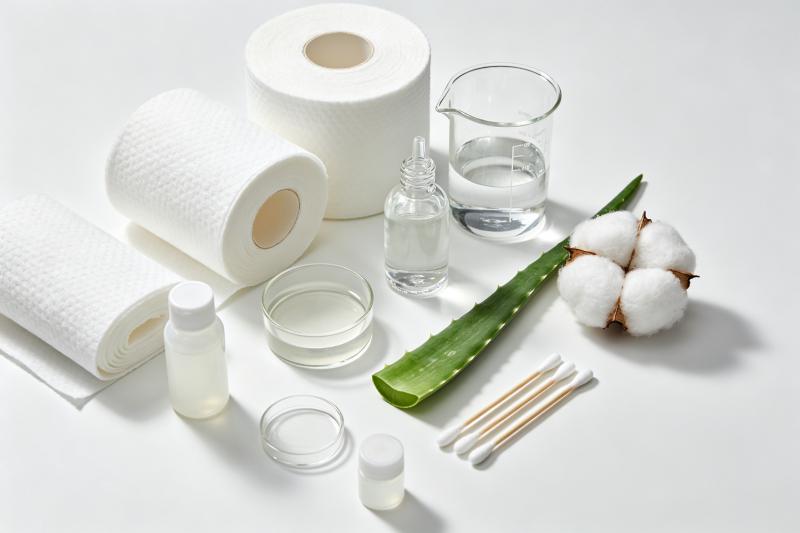
2. Key Raw Materials
2.1 Nonwoven Substrate
The fabric is the single most expensive component, typically accounting for 35-50% of total material cost. Key options include:
- Polyester/Viscose Blends (e.g., 70/30, 50/50): The most common and cost-effective option. Polyester provides strength and bulk; viscose provides absorbency and softness.
- 100% Viscose/Rayon: Premium option with excellent absorbency and biodegradability. Higher cost, commonly used for organic and eco-friendly positioning.
- Cotton Blends: Used for premium baby and facial wipes. Cotton provides natural softness but at a significant cost premium.
- Airlaid Paper: Used for industrial and cleaning wipes where high absorbency and low cost are priorities.
2.2 Wipe Lotion Components
The lotion typically makes up 60-75% of the finished product weight and consists of:
- Water (90-98% of lotion): Must be purified (RO or DI water) to meet microbiological and purity standards.
- Humectants (e.g., glycerin, propylene glycol, sorbitol): Prevent the wipe from drying out and provide skin moisturization. Typical usage: 1-5%.
- Surfactants (e.g., polysorbate 20, decyl glucoside): Provide cleaning power by reducing surface tension. Typical usage: 0.1-2.0%.
- Preservatives (e.g., phenoxyethanol, ethylhexylglycerin, sodium benzoate, potassium sorbate): Prevent microbial growth during the product's shelf life (typically 2-3 years). Usage varies by preservative system.
- pH Adjusters (e.g., citric acid, sodium citrate): Maintain pH in the skin-friendly range of 4.5-6.0.
- Skin Care Additives (e.g., aloe vera, chamomile extract, vitamin E, allantoin): Optional premium ingredients for marketing claims.
- Fragrance: Optional, used for scented variants. Must be IFRA-compliant and dermatologically tested.
3. Formulation Considerations by Product Type
3.1 Baby Wipes
Baby wipes require the gentlest formulation. Key considerations:
- pH 4.5-5.5 to match baby skin's acid mantle
- Alcohol-free, paraben-free, and hypoallergenic claims require specific formulation choices
- Preservative systems must be mild but effective (common: phenoxyethanol + ethylhexylglycerin)
- Fabric should be soft, lint-free, and durable (typically 40-60 GSM spunlace)
- Common certifications: dermatologically tested, hypoallergenic, OEKO-TEX 100
3.2 Adult/Personal Care Wipes
Includes intimate wipes, facial wipes, and body wipes. Formulations may include:
- Intimate wipes: pH 3.8-4.5 to match intimate area, with gentle surfactants and soothing agents
- Facial cleansing wipes: may include makeup-removing surfactants and skincare actives
- Body wipes: higher cleaning power with moisturizing agents
3.3 Household and Cleaning Wipes
These prioritize cleaning efficacy over skin gentleness:
- Higher surfactant loading (2-5%)
- May include disinfectants (e.g., benzalkonium chloride, hydrogen peroxide) for antibacterial claims
- Glass wipes: may include isopropyl alcohol or ethanol for streak-free cleaning
- Fabric: typically heavier (50-80 GSM) with textured surface for scrubbing
3.4 Industrial and Institutional Wipes
Designed for heavy-duty cleaning in commercial settings:
- High absorbency airlaid or meltblown fabric
- Strong degreasing surfactants and solvents
- Large format (e.g., 25x30cm) and high pack counts
- May be pre-saturated or dry wipes used with separate cleaning solution
4. Quality Control and Testing
4.1 Incoming Material Inspection
Every batch of raw materials undergoes inspection upon arrival:
- Nonwoven fabric: GSM verification, tensile strength, absorbency rate, visual inspection for defects
- Lotion ingredients: COA verification, pH, viscosity, microbiological testing
- Packaging materials: seal strength, lid adhesion, print quality verification
4.2 In-Process Quality Control
During production, QC teams monitor:
- Lotion pickup rate (gravimetric verification every 30 minutes)
- Wipe count per pack (automatic counters with manual spot checks)
- Seal integrity (pressure and visual checks)
- pH of finished wipes (spot testing every 2 hours)
- Visual defects (fabric holes, folding errors, packaging misalignment)
4.3 Finished Product Testing
Before release, each production batch undergoes:
- Microbiological testing: Total aerobic count, yeast/mold, and specific pathogens (E. coli, S. aureus, P. aeruginosa, C. albicans) per USP 61/62 or EP 2.6.12/2.6.13 standards
- Preservative efficacy test (PET): Challenge test per USP 51 or ISO 11930 to verify the preservative system can control microbial contamination
- Stability testing: Accelerated stability (40°C/75% RH for 3 months) and real-time stability to verify shelf life claims
- Physical testing: Tensile strength, wet strength, absorbency capacity, lotion content verification
- Packaging integrity: Seal strength, drop test, vibration test for transport simulation
5. Certifications and Compliance
Depending on your target market and product positioning, relevant certifications include:
| Certification | Applicable Products | Key Requirement |
|---|---|---|
| ISO 9001 | All | Quality management system |
| ISO 13485 | Medical-grade wipes | Medical device quality management |
| ISO 22716 (GMP) | Cosmetic wipes | Cosmetic Good Manufacturing Practices |
| CE Marking | EU market | EU health, safety, and environmental protection standards |
| FDA Registration | US market | FDA facility registration and product listing |
| OEKO-TEX 100 | Baby/premium wipes | Textile free from harmful substances |
| FSC Certified | Cellulose-based wipes | Responsible forestry sourcing |
| OK Compost/OK Biodegradable | Eco-friendly wipes | Compostability and biodegradability verification |
| Halal Certified | Middle East market | Ingredients and process comply with Islamic law |
6. OEM/ODM Customization Options
6.1 Private Label (OEM)
For brands with an existing formulation or who want to use the manufacturer's standard formula:
- Custom branding on packaging (logo, design, copy)
- Choice from manufacturer's existing formula library
- Custom pack sizes and counts
- Typical MOQ: 30,000 packs per SKU
- Lead time: 30-45 days after artwork approval
6.2 Custom Formulation (ODM)
For brands wanting a unique formula:
- Custom lotion development based on brand specifications
- Custom fabric selection and weight
- Unique fragrance development
- Specialty ingredients (organic, natural, functional additives)
- Typical MOQ: 30,000 packs per SKU
- Formula development time: 4-8 weeks (including stability testing)
- Lead time: 45-60 days after formula and artwork approval
6.3 Packaging Customization
- Pouch material: standard PE, EVOH barrier for extended shelf life, recyclable mono-material
- Lid type: standard flip-top, easy-open label, hard plastic tub
- Printing: up to 8-color rotogravure or flexographic printing
- Special finishes: matte, soft-touch, holographic, spot UV
- Flowpack/single-serve options for travel and sample sizes
7. Cost Structure and Pricing Factors
Wet wipe manufacturing costs are driven by several key factors:
- Fabric GSM and material type: The largest cost driver. Moving from 40 GSM polyester/viscose to 60 GSM 100% viscose can increase fabric cost by 60-80%.
- Lotion formulation: Premium ingredients (organic extracts, specialty preservatives, high-end fragrances) significantly increase lotion cost.
- Pack count and pack size: Larger packs have lower per-wipe packaging cost but higher unit cost.
- Packaging complexity: EVOH barrier pouches, 8-color printing, and special finishes add cost.
- Order volume: MOQ pricing vs. full container pricing can differ by 15-25%.
- Certification requirements: Organic, biodegradable, and medical-grade certifications require additional testing and premium materials.
As a rough benchmark, standard baby wipes (50 GSM polyester/viscose, standard formula, 80-count flip-top pack) in full container volumes typically range from $0.15 to $0.30 FOB per pack, depending on specifications and order volume. Premium organic formulations and 100% viscose fabric can push this to $0.40-$0.60 per pack.
8. How to Select a Wet Wipes Manufacturer
When evaluating potential OEM partners, consider these criteria:
- Production capacity: Verify the manufacturer has dedicated wipes converting lines and can meet your volume requirements. New Yifa Group operates multiple high-speed wipes lines with annual capacity exceeding 500 million packs.
- Cleanroom standards: Wipes production should occur in a controlled cleanroom environment (typically Class 100,000 or better) to minimize microbiological contamination risk.
- In-house lab capabilities: A manufacturer with an in-house QC lab can perform microbiological testing, stability testing, and formulation development without relying on third-party labs, reducing lead times and improving quality control.
- Certification portfolio: Verify relevant certifications (ISO 9001, ISO 13485, GMP, FDA, CE) are current and applicable to wipes production.
- Formula development expertise: For ODM projects, verify the manufacturer has experienced formulation chemists and can develop custom formulas meeting your specifications.
- Quality track record: Request references from existing clients, particularly in your product category and target market. Ask about rejection rates, on-time delivery performance, and responsiveness to quality issues.
- Supply chain resilience: Verify the manufacturer has reliable raw material sourcing, particularly for nonwoven fabric and key lotion ingredients. Dual sourcing and strategic inventory buffers reduce supply chain risk.
9. Common Pitfalls to Avoid
- Underestimating stability testing time: Custom formulas require 3 months of accelerated stability testing before production release. Factor this into your launch timeline.
- Ignoring preservative efficacy: A weak preservative system can lead to microbial contamination, product recalls, and brand damage. Always require PET (preservative efficacy testing) results.
- Overlooking packaging barrier properties: Standard PE pouches allow moisture loss over time, leading to dried-out wipes. EVOH barrier pouches extend shelf life significantly, especially for warm-climate markets.
- Not specifying fabric direction: Spunlace fabric has a machine direction and cross direction with different tensile properties. Specify which direction should align with the wipe's length to optimize strength and softness.
- Skipping pre-production samples: Always request and approve pre-production samples (PPS) before mass production. Verify fabric feel, lotion scent, pH, pack quality, and print accuracy against your specifications.
Looking for an OEM Partner?
New Yifa Group is a leading hygiene product manufacturer in China since 1994, with 68 production lines and exports to 88+ countries. We offer OEM/ODM services for baby wipes, adult wipes, cleaning wipes, household wipes, and pet wipes with low MOQ, custom packaging, and ISO 13485/CE/FDA certification.
Explore our wet wipes OEM capabilities | Request a free quote