
Introduction: Your Manufacturer Choice Defines Your Brand
Choosing the wrong OEM adult diaper manufacturer costs more than money — it costs time, market reputation, and in the worst case, regulatory compliance failures that block your products from pharmacy shelves entirely. After three decades in OEM adult incontinence manufacturing, we have seen buyers make the same mistakes repeatedly: prioritizing the lowest FOB quote over factory certifications, skipping on-site audits, or failing to verify supply chain traceability.
This checklist is built from real procurement experience. Use it whether you are comparing 3 factories or 30.
The 12-Point OEM Adult Diaper Manufacturer Checklist
1. ISO 13485 Certification — Non-Negotiable for Medical-Grade Products
Adult diapers are regulated as medical devices in the EU (MDR 2017/745 Class I), the US (FDA 21 CFR Part 820), and an increasing number of markets across Asia and the Middle East. If your manufacturer does not hold ISO 13485:2016 — the medical device quality management system standard — you cannot sell into regulated pharmacy and hospital channels.
- What to verify: Certificate number, issuing body (NQA, SGS, TÜV, BSI), scope statement, and expiry date. Cross-check the certificate on the issuing body's public database.
- Red flag: Factory claims "ISO certified" without specifying the standard number or issuing body.
View our ISO 13485 certification and complete compliance documentation →
2. Factory Audit History — BSCI, SGS, or Equivalent Third-Party Verification
ISO certifications are necessary but not sufficient. A factory can hold an ISO certificate and still have unsafe working conditions, poor environmental controls, or inadequate quality processes. Look for independent third-party audits:
- BSCI (amfori) — Social compliance covering working hours, wages, safety, and no forced labor
- SGS / Bureau Veritas / Intertek — Technical factory audits covering production capability, QC systems, and hygiene controls
- Sedex SMETA — Ethical trade audit widely recognized by EU retailers
Request the most recent audit report and score. A BSCI "A" or "B" grade signals a well-managed facility.
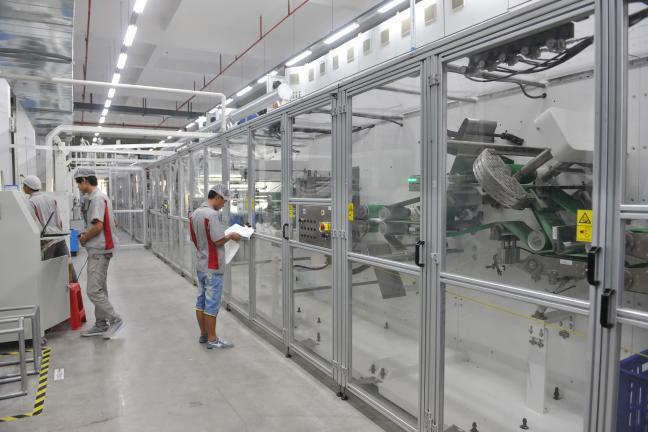
3. Production Line Configuration — Cleanroom Class and Equipment Origin
Not all adult diaper production lines are equal. Three factors determine output quality:
- Cleanroom classification: Medical-grade adult diapers require at minimum a 100,000-class cleanroom (ISO 8). Higher classifications (10,000-class / ISO 7) are required for sterile products.
- Equipment origin: Japanese (Zuiko, Kao) and European (Fameccanica, GDM) lines deliver tighter tolerances and higher speeds (400–600 pcs/min) than domestic Chinese equipment.
- In-line QC capability: Does each line have X-ray SAP distribution scanning, vision inspection for tape placement, and automatic rejection of out-of-spec units?
See our actual production floor — real factory photos →
4. SAP and Raw Material Supply Chain Traceability
Super-Absorbent Polymer (SAP) is the most critical raw material in adult diapers — it determines absorption capacity, rewet performance, and skin safety. Your manufacturer should be able to trace every batch of SAP back to its supplier (Nippon Shokubai, BASF, Evonik, Sanyo Chemical, or domestic equivalent) and provide Certificate of Analysis (CoA) for each lot.
- What to ask: "Can you provide supplier name, CoA, and ISO 17190-6 test reports for the SAP grade used in my product?"
- Red flag: Manufacturer uses "generic" SAP without batch traceability or switches suppliers without informing you.
5. Absorption Performance — Beyond the Marketing Numbers
Every factory quotes an absorption capacity number (2,000ml, 3,000ml, etc.). Test these yourself:
- Acquisition rate (ISO 11948-1): How fast does the liquid absorb? Slow acquisition = leakage.
- Rewet under pressure (0.7 kPa / 1.0 kPa): How much liquid comes back out when pressure is applied? This is the #1 factor in skin health.
- Retention after centrifugation: How much fluid the core actually holds versus releases.
Request test reports for all three metrics, not just total capacity. Ask for competitor benchmark data if available.
6. Customization Depth — Beyond Logo Printing
True OEM manufacturing means you control the product, not just the packaging. Verify the manufacturer can customize:
- SAP-to-pulp ratio (adjusting absorption speed and capacity)
- Topsheet material (standard nonwoven, cotton-feel, aloe-infused, pH-balanced)
- Backsheet type (breathable PE film, cloth-like, anti-slip coating)
- Tape system (refastenable frontal tape, hook-and-loop, double tape)
- Wetness indicator (color change chemistry, custom brand message printed)
- Odor control (active carbon layer, botanical extract, pH-balanced core)
- Elastic tension (standard, gentle for sensitive skin)
- Size range (standard M/L/XL plus bariatric XXL/XXXL)
Explore our full customization range — all parameters adjustable →
7. MOQ Flexibility — Not All 50,000 MOQs Are Equal
Standard adult diaper MOQ is typically 50,000 pieces. But dig deeper:
- Is the MOQ per SKU or per order? Per-order MOQ allows mixing sizes and variants.
- Is there a trial order program? First-time buyers should be able to order reduced quantities.
- What is the sample policy? Free existing-platform samples? Paid custom development samples with credit toward first order?
8. Packaging Design Turnaround and Regulatory Labeling
Custom packaging is often the longest bottleneck in OEM projects. Clarify:
- Design turnaround: How many business days from brief to first artwork proof?
- Regulatory review: Does the manufacturer review your label against target market regulations (FDA labeling requirements, EU MDR labeling, UKCA, TGA)?
- Supported formats: PE bag, carton box, display-ready retail pack, sterile hospital pouch, bulk institutional packaging.
9. QC Sampling Standards — AQL Levels and Testing Frequency
Understand the sampling plan used for your order:
- AQL 1.5 should apply to critical defects (SAP leakage, missing tape, contamination)
- AQL 2.5 for major defects (elastic recovery, core uniformity, tape adhesion)
- In-line QC frequency: Every 30 minutes is industry standard for medical-grade production
- Pre-shipment inspection: ANSI/ASQ Z1.4 sampling plan, ISTA 1A carton drop test
Our 4-stage QC system — IQC → In-Process → AQL → FRI →
10. Regulatory Documentation Package
You should receive a complete regulatory dossier with every production batch:
- Technical File (for CE marking)
- Declaration of Conformity
- Certificate of Analysis per batch
- Material certificates (CoA for SAP, nonwoven, PE film, adhesive)
- Third-party lab test reports (if requested)
If the manufacturer cannot provide these documents — or charges extra for them — consider it a major red flag.
11. Shipping and Logistics — Incoterms, Lead Times, Port Proximity
- Incoterms offered: FOB (Xiamen/Putian), CIF, DDP for qualified buyers
- Sea freight times: 2–4 weeks Southeast Asia, 3–5 Middle East/Africa, 4–6 Europe/USA
- Container utilization: One 40HQ ≈ 150,000–180,000 adult diapers (tab-style)
- Export documentation: Commercial Invoice, Packing List, Bill of Lading, Certificate of Origin (Form A/E/F)
12. Communication and Project Management
The best factory specifications mean nothing if communication fails. Before signing, answer these:
- Response time: Does the sales team reply within 12–24 hours (business days)?
- English proficiency: Can you discuss technical specifications without translation errors?
- Dedicated project manager: Will one person own your project from inquiry to delivery?
- Factory visit policy: Is an on-site visit welcomed? If the factory hesitates, ask why.
Quick Self-Assessment Scorecard
Rate each manufacturer on these 12 points (1 = fails, 5 = excellent):
| # | Criteria | Weight | Score |
|---|---|---|---|
| 1 | ISO 13485 certification | Critical | /5 |
| 2 | Third-party audit (BSCI/SGS) | High | /5 |
| 3 | Production line quality | High | /5 |
| 4 | SAP traceability | Critical | /5 |
| 5 | Absorption test reports | High | /5 |
| 6 | Customization depth | Medium | /5 |
| 7 | MOQ flexibility | Medium | /5 |
| 8 | Packaging design turnaround | Medium | /5 |
| 9 | QC sampling standards | Critical | /5 |
| 10 | Regulatory documentation | High | /5 |
| 11 | Shipping & logistics | Medium | /5 |
| 12 | Communication quality | High | /5 |
Scoring: 50–60 = Strong partner | 40–49 = Acceptable with improvements | Below 40 = Keep looking
Next Step: Start Your OEM Evaluation
The difference between a successful adult incontinence brand and a failed one often comes down to manufacturer selection. Use this checklist when evaluating factories — including ours. We welcome the scrutiny.
Request your OEM feasibility assessment → — includes MOQ estimate, sample timeline, and FOB pricing within 12 business hours.
Tour our ISO 13485 certified factory → — real photos, real certifications, real production data.