
Why Raw Material Specs Matter More Than the FOB Price
When you’re comparing OEM quotes, the FOB price per piece gets all the attention. What rarely gets discussed upfront is how much of that price is driven by raw material specifications — and how those specifications directly determine whether your product performs in the market or comes back as returns.
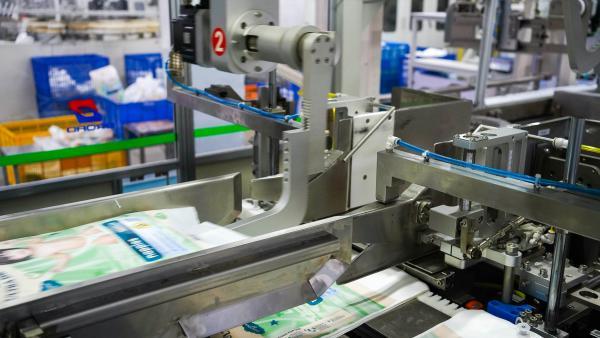
A baby diaper has four primary raw material components. Together they account for 78-85% of the ex-factory cost. The remaining 15-22% is labor, energy, packaging, and margin. When a factory quotes you a price that’s 8% lower than the market average, the first place to look is which material specification changed.
| Component | Cost Share | Performance Impact |
|---|---|---|
| Superabsorbent Polymer (SAP) | 22-30% | Absorbency capacity, rewet control |
| Nonwoven (topsheet & backsheet) | 18-24% | Skin feel, breathability, leakage |
| PE film (backsheet film) | 12-16% | Waterproofing, breathability |
| Fluff pulp | 14-20% | Core integrity, absorption speed |
| Elastic & tape systems | 10-14% | Fit, leakage prevention |
| Other (ADL, release paper, etc.) | 6-10% | Acquisition speed, structural stability |
At our Putian facility, we source SAP from three tier-1 suppliers and maintain a 15-day strategic inventory. That’s not standard across the industry. If you’re evaluating manufacturers, ask when they last changed SAP suppliers and why. A manufacturer that can’t give you a straight answer on their SAP sourcing is outsourcing the most performance-critical decision in your product.
Superabsorbent Polymer (SAP): The Single Biggest Performance Variable
SAP is the granular polymer that turns liquid into gel. Its quality determines three things that consumers notice immediately: how much the diaper holds, whether it leaks under pressure, and whether it gets soggy or stays dry to the touch.
Here’s what the specification sheet should tell you — and what most factories won’t volunteer:
Free Swell Capacity (ISO 17190-6)
This is the baseline number: how much liquid 1 gram of SAP can absorb in a zero-pressure environment. The industry range is 30-45 g/g. Anything below 30 g/g is low-grade SAP that will show rewet problems within 30 minutes of use. Anything above 45 g/g is premium grade, typically Japanese or German origin (Nippon Shokubai, BASF). Chinese domestic SAP has improved significantly in the past 5 years — current top-tier domestic grades reach 38-42 g/g, which is perfectly adequate for mid-range products.
We use 38-42 g/g SAP as standard for our OEM baby diaper formulations. For premium SKUs, we step up to 44-48 g/g imported SAP.
Absorbency Under Load (AUL)
Free swell is a laboratory number. AUL measures absorbency when a weight is applied — simulating a baby lying or sitting. The standard test uses 0.7 kPa pressure (ISO 17190-6). A well-formulated core retains 60-75% of free-swell capacity under 0.7 kPa load.
If a factory quotes you a product with “800ml absorbency” but can’t show you the AUL test result at 0.7 kPa, they’re quoting a laboratory number that field performance won’t match. Ask for the AUL number specifically.
SAP Dosage and Distribution
Dosage is measured in grams per diaper. A typical premium baby diaper (size M) uses 6-9g of SAP. Economy grades use 3-5g. The SAP has to be distributed uniformly across the core — not just dumped in the center. X-ray inspection of the core during production (we do this every 30 minutes) is the only way to verify uniform distribution.
If you’re comparing two quotes and Quote A uses 4g SAP while Quote B uses 7g, the $0.015/piece price difference is buying you significantly reduced leakage claims. The math is straightforward once you know the SAP dosage.
Nonwoven: Topsheet and Backsheet
Nonwoven fabric is the part of the diaper that touches the baby’s skin (topsheet) and the outer layer that prevents leakage (backsheet, which is often a nonwoven-PE composite).
Topsheet: Spunbond vs. Hot Air Through
Two main technologies:
- Spunbond (SS, SSS): Cheaper, slightly coarser handfeel. Adequate for economy products. Basis weight typically 16-20 gsm.
- Hot Air Through (HAT): Softer, more cotton-like handfeel. The industry standard for mid-to-premium. Basis weight typically 18-25 gsm. The HAT process creates a more open structure, which improves acquisition speed — how fast liquid passes through the topsheet into the core.
A proper topsheet also has hydrophobic treatment — meaning it repels liquid that’s already passed through. Without this treatment, the topsheet stays wet after the first void, and the baby feels damp. You can test this yourself: pour 20ml of saline onto the topsheet of a sample, wait 30 seconds, then press a dry tissue onto the surface. If the tissue picks up moisture, the topsheet has a rewet problem.
We use HAT nonwoven as standard for all PalmBaby OEM formulations. The hydrophilic/hydrophobic balance is calibrated for each SKU based on the target market’s climate (higher humidity markets need faster acquisition).
Backsheet: Breathable PE Film vs. Cloth-like Nonwoven
The backsheet needs to be waterproof while allowing water vapor to escape (breathability). Two approaches:
- Breathable PE film: PE film with micro-perforations. MVTR (Moisture Vapor Transmission Rate) of 2000-4000 g/m²/24h is the mid-range standard. Premium products go to 5000+. Measured per ISO 2528.
- Cloth-like backsheet: Nonwoven + PE laminate. More cloth-like handfeel, slightly higher cost. Preferred in markets where “cloth-like” is a marketing claim (North America, Western Europe).
Breathability matters for skin health. A non-breathable backsheet traps heat and moisture, creating conditions for diaper dermatitis. If you’re selling to the EU or markets with strong dermatological awareness, specifying MVTR > 2500 is worthwhile.
Fluff Pulp: The Core’s Structural Component
Fluff pulp is the fibrous component that gives the diaper core its shape and helps with acquisition speed — the rate at which liquid moves from the topsheet into the SAP.
Two sources dominate the market:
- Northern bleached softwood kraft (NBSK): Longer fibers, better core integrity, higher absorption speed. Primarily from Scandinavia (Stora Enso, UPM) and Canada. More expensive.
- Recycled / mixed tropical pulp: Shorter fibers, lower cost, adequate for economy products. Core can deform more easily after multiple voids.
A well-engineered core uses fluff-SAP blend ratio of 1.2:1 to 1.5:1 (by weight). Too much fluff and the diaper gets bulky. Too much SAP and the core can gel-block (SAP forms a gel layer on the surface that slows subsequent acquisition).
We use NBSK pulp as standard across all OEM formulations. The fluff-to-SAP ratio is calibrated per SKU based on the target absorption capacity and the product’s thickness specification.
Elastic Systems and Tape: The Fit Determinants
A diaper can have perfect absorption and still leak because the fit is wrong. The elastic system (waistband and leg cuff) and the tape (or hook-and-loop) system determine fit.
Waistband and Leg Cuff Elastic
Elastic is specified by denier (thickness of the filament) and pre-tension (how much it retracts after stretching). The key performance metric is elastic retention after 5 wash cycles — simulating repeated stretching during wear. If the elastic relaxes too much, the diaper sags and leaks.
A good manufacturer tests elastic retention on every raw material batch. The acceptance criterion is typically < 15% relaxation after 5 cycles. Ask to see the incoming QC log for elastic — if they don’t have one, they’re not testing it.
Tape / Hook-and-Loop System
Two main systems:
- Adhesive tape: Traditional system, lower cost. Tape peels off the landing zone and re-fastens 2-3 times before losing adhesion.
- Hook-and-loop (magic tape): Re-fastenable multiple times, preferred for premium products and pants-style diapers. More expensive (adds approximately $0.015-0.025/piece).
If you’re targeting the premium segment, hook-and-loop is worth the cost. If you’re targeting price-sensitive markets, adhesive tape is adequate — but specify re-fastenability of at least 2 times in your quality agreement.
How Material Specifications Translate to FOB Price
Here’s a realistic price breakdown for a Size M baby diaper, comparing an economy specification to a premium specification:
| Component | Economy Spec | Premium Spec | Price Diff/Piece |
|---|---|---|---|
| SAP dosage | 4g, 32 g/g | 8g, 42 g/g | +$0.018 |
| Nonwoven (topsheet) | Spunbond 18gsm | HAT 22gsm | +$0.008 |
| Backsheet | Non-breathable PE | Breathable PE 3000 MVTR | +$0.005 |
| Fluff pulp | Mixed tropical | NBSK | +$0.007 |
| Elastic & tape | Std elastic + tape | Premium elastic + hook-loop | +$0.012 |
| Total FOB difference | - | - | +$0.050/pc |
The $0.050/piece difference translates to approximately $2.50 more per pack of 50. Whether that’s justifiable depends on your target market. In a price-sensitive market, the economy spec may be the right call. In a market where diaper rash and leakage drive brand switching, the premium spec pays for itself in reduced returns and higher repurchase rates.
The key point: when you’re comparing two OEM quotes that differ by $0.03-0.06/piece, the difference is almost always in these material specifications. Ask for the Bill of Materials (BOM) breakdown in the quotation. A manufacturer that can’t provide one is hiding something.
Regulatory and Compliance Considerations by Material
Raw materials are also where regulatory compliance either starts or fails.
- SAP: Must be non-toxic and skin-safe. For EU market, must comply with REACH SVHC (Substances of Very High Concern) list. Ask for the SAP supplier’s REACH compliance declaration.
- Nonwoven: Must pass skin sensitization and irritation tests (ISO 10993-10). For baby products, dermatological testing is increasingly expected in EU and North America.
- PE film: Must be phthalate-free. For EU, complies with REACH Annex XVII. For US, complies with CPSIA phthalate restrictions.
- Elastic/adhesives: Must be formaldehyde-free and low-VOC. For EU, must pass OEKO-TEX Standard 100 Class A (baby products).
At minimum, your OEM partner should be able to provide full material compliance documentation for each raw material used in your product. If they can’t, and you’re selling into a regulated market, you’re assuming regulatory risk that’s not visible in the FOB price.
Our raw material incoming QC process includes certificate verification for every batch: REACH declaration for SAP, OEKO-TEX for nonwoven, phthalate-free certificate for PE film, and formaldehyde test report for elastic/adhesives. These are kept on file and provided as part of the technical dossier for EU MDR or US FDA registration.
Questions to Ask About Raw Materials Before You Sign
- “Can I see the Bill of Materials (BOM) with grammage and supplier grade for each component?” If the answer is no, or “it’s proprietary,” keep looking.
- “What is the SAP free-swell capacity and AUL at 0.7 kPa for the proposed formulation?” A manufacturer that knows their formulation can answer this immediately.
- “Which SAP supplier do you use, and can I specify an alternative?” Having at least two qualified SAP suppliers is a risk-mitigation practice. Single-source SAP is a supply chain vulnerability.
- “Can I see the incoming QC log for nonwoven tensile strength and PE film MVTR from the last 3 batches?” This tells you whether they actually test, or whether “quality control” is a slogan.
- “What’s the fluff-to-SAP ratio in the proposed core, and why was it chosen?” There’s no single right answer, but there is a wrong answer: “I don’t know, our formula guy handles that.” You want the formula guy’s reasoning, not a deflection.
Final Thought
The FOB price per piece is what gets you to sign. The raw material specification is what determines whether your customers repurchase. A $0.03/piece saving on materials that causes a 2% return rate is a net loss — and that’s before counting the brand damage.
If you’re in the specification or quotation stage and want to talk through material options for your target market, our technical team is available at +86 181 5938 0105 or sales@newyifagroup.com. We can run a side-by-side absorption test on your current product vs. a proposed formulation, so you can see the performance difference before you commit to a production run.
Factory visits are available in Putian, where you can see the raw material incoming QC process, the SAP dosing calibration, and the finished product AQL inspection — all of which are easier to evaluate in person than through a quotation sheet.
References: ISO 17190-6:2020 — Determination of free-swell capacity of superabsorbent powders and granules. ISO 2528:2017 — Determination of water vapor transmission rate. ISO 10993-10:2021 — Biological evaluation of medical devices: Tests for skin sensitization and irritation. REACH Regulation (EC) No 1907/2006 — SVHC compliance for SAP and nonwoven materials. This article reflects manufacturing experience in the hygiene products sector since 1994.